
What Is an AI Operating System and Why Does Every SMB Need One?
Quick Answer
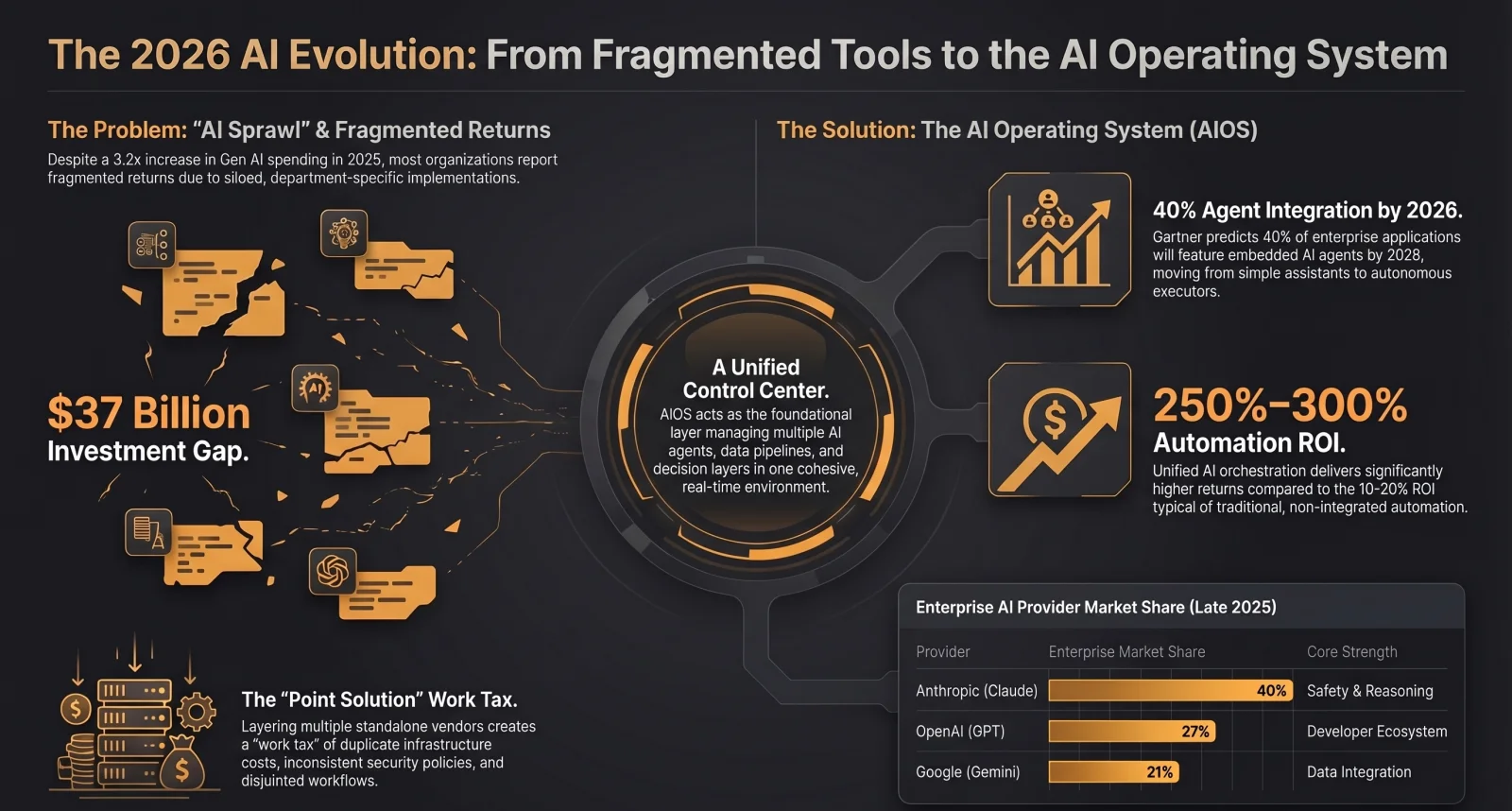
An AI Operating System (AIOS) is a centralized workspace that holds your entire business context — strategy documents, client history, brand guidelines, financial data — and connects to your existing platforms via API integrations. Instead of building standalone automations that each need their own context, you build once on a foundation that already knows your business. Enterprises invested $37 billion in generative AI during 2025, and Menlo Ventures reports that Anthropic now leads enterprise AI adoption with 40% market share. The shift from point solutions to AIOS-based automation delivers 250-300% ROI compared to 10-20% for traditional automation.
Key Answers
- What is an AI Operating System?
- An AI Operating System is a centralized layer that manages your AI agents, tools, workflows, and data pipelines in one place. It gives every automation access to the same business context — your strategy, clients, processes, and connected platforms — so nothing starts from scratch.
- How is an AIOS different from individual AI tools?
- Individual AI tools are point solutions. Each one solves a single problem and needs its own context. An AIOS is the foundation layer underneath all of them — shared context, shared integrations, shared memory. One workspace that powers everything.
- How much does it cost to set up an AIOS for a small business?
- A typical AIOS setup costs $5,000-$10,000 for the initial build (context configuration, API integrations, first automation), followed by $2,500-$6,000 per month for ongoing development and maintenance. Most businesses see positive ROI within the first 30 days.
- Can a non-technical business owner use an AI Operating System?
- Yes. The AIOS handles the technical complexity. Business owners interact through a chat interface or simple commands, describing what they need in plain language. The system already knows enough about the business to execute without lengthy briefings.
Key Takeaways
- Enterprises invested $37 billion in generative AI during 2025, but the majority report fragmented returns because they deployed point solutions instead of unified platforms.
- AI automation built on a contextualized AIOS delivers 250-300% ROI compared to 10-20% for traditional automation, according to Swfte AI research.
- Anthropic (Claude) now holds 40% of enterprise AI market share, ahead of OpenAI at 27% and Google at 21%, based on Menlo Ventures analysis.
- A typical AIOS retainer starts at $2,500 per month and scales to $5,000-$6,000 as the system grows — replacing the need for dedicated developers or multiple SaaS subscriptions.
- Multi-agent systems running on a shared AIOS reduce process hand-offs by 45% and improve decision speeds by 3x compared to disconnected automation tools.
Why Are Businesses Outgrowing Individual AI Tools?
Because every standalone AI tool starts from zero context. You brief it, it does the thing, and then it forgets. The next tool needs the same briefing. Scale that across a business and you are spending more time feeding AI than the AI saves you.
Enterprises invested $37 billion in generative AI during 2025 — a 3.2x jump from $11.5 billion the year before. But according to Swfte AI, the majority report fragmented returns. The money went in. The value did not come back at the same rate. The culprit is almost always the same: each department picked its own AI tool, each tool operates in its own silo, and none of them talk to each other or share business context.
Ian Shakil, Chief Strategy Officer at Commure, put it bluntly: "There are far too many point solutions degrading the digital revolution, and now is the time to consolidate rationally to platform partners." A 2023 survey found that 55% of health system clinicians and CIOs use between 50 and 500 software solutions to operate their organisations. That fragmentation creates duplicate costs, compliance headaches, and a user experience that makes people want to throw their laptop out a window.
And this is not only a healthcare problem. The average enterprise runs 47 SaaS applications. If you want to understand how those subscription costs compound, our breakdown of the hidden costs of SaaS sprawl shows how a $200 per month tool stack can actually cost $2,000 when you factor in integration middleware, context-switching overhead, and security reviews.
What Is an AI Operating System?
An AI Operating System is a centralized workspace that holds your business context, connects to your platforms via APIs, and acts as the foundation for every automation you build. Context first, integrations second, automations on top.
Think of it this way. Your business has a strategy document, a client list, pricing guidelines, brand voice rules, financial data, and a dozen other things that make you "you." Right now, every time you use an AI tool, you re-explain some version of that. An AIOS inverts the model. You configure the context once — who you are, what you sell, how you operate, who your clients are — and every automation you build from that point forward already knows the answers.
Then you layer in integrations. Stripe for payments. Your CRM for pipeline data. Google Analytics for traffic. Meta Ads for campaign performance. The AIOS can now pull live data from any of these systems, act on it, and write back. A founder running this setup can ask "how did our Facebook ads perform last week?" and get an answer that references their actual account data, their actual spend, and their actual conversion numbers. No dashboard-hopping. No exporting CSVs into ChatGPT.
The third layer is automation. With context and integrations in place, building a new workflow shrinks from weeks to hours. Need a weekly report that pulls Google Analytics traffic, cross-references it with Stripe revenue, and emails a summary to your team? That goes from "hire a developer" to "describe what you want in plain English." The pathway to automation shrinks because the hard part — the context and the connections — is already done.
How Does Top-Down Automation Differ From Bottom-Up?
Top-down automation starts with identifying a process, then building a bespoke solution for it. Bottom-up automation starts with a contextualized foundation, then any process you want to automate is a conversation away.
The traditional way of bringing AI into a business looks like this: you hire a consultant, they run a 4-8 week audit, they map out your processes, they identify what could be automated, and then they build custom solutions one at a time. Each solution is a standalone agent or workflow with its own context, its own integrations, its own maintenance burden. This is the "point solution" approach and it works. But it is slow, expensive, and each build starts from scratch.
Liam Ottley, who has been installing Claude Code AIOS setups for founders at in-person masterminds in Cape Town and Bali, describes it as "digging with a teaspoon." Each automation is hand-crafted, context is manually injected, and the next build does not benefit from the last one. You have done a lot of work but you have not built a system.
The bottom-up model flips this. You start with the AIOS — context and integrations — and then the auditing and development happen organically. A founder sits down with their workspace, types a command like /explore, and describes the problem they want solved. The system already knows the business, already has the API connections, so the gap between "I want this" and "it is running" collapses from weeks to hours. Multi-agent systems built on this shared foundation reduce process hand-offs by 45% and improve decision speeds by 3x.
What Does an AIOS Look Like in Practice?
At ManaTech, we run our entire business from a Claude Code workspace. Strategy, client management, content production, ad campaigns, analytics — all orchestrated through one contextualized system.
Our workspace has three layers. Layer 1 is Intent — markdown files that define our business strategy, client information, pricing guidelines, and standard operating procedures. Layer 2 is Orchestration — Claude reads those files and makes decisions about what to do and how to sequence work. Layer 3 is Execution — scripts and API integrations that do the repetitive parts: deploying code, uploading ads, pulling analytics data, sending emails.
When we write a blog article, the system reads the blog-writing skill (a markdown document that defines the full pipeline), searches YouTube and the web for source material, creates a NotebookLM research notebook, generates six resource types (audio, slides, report, quiz, data table, infographic), then writes the article using that research and our brand voice guidelines. The same workspace knows our client projects, can pull live Google Analytics data via the GA4 API, upload Meta ad campaigns via the Marketing API, and send drafts via Gmail. One workspace. One context. Everything connected.
If you want a closer look at how Claude Code functions as a business tool, our guide on what business owners can realistically build with Claude Code covers the practical capabilities and limitations.
What Are the Three Delivery Models for AIOS Services?
Training (teach the founder to fish), Agency Retainer (fish for them monthly), and Productized Service (sell them a fishing rod that works out of the box). Each model suits a different type of business owner.
The Training model costs around $5,000 for setup. A consultant flies out (or meets remotely), configures the context and integrations, solves one major business problem during the session, and trains the founder to use the workflows themselves. Ongoing support runs $1,000-$2,000 per month with weekly calls. This works well for technically curious founders — digital marketing agency owners, ecommerce operators, people who are already playing with AI and want to go deeper. The risk is obvious: once they learn, they start teaching others.
The Agency Retainer model is different. Tyler, who has been doing in-person AIOS installs across America, charges $5,000 for the initial fly-out and setup, then $2,500 per month for one to two automations per month. He does not teach the founder to build. Instead, he sets up a fully contextualized workspace on his side — the development engine — and creates a simple chat interface for the founder to interact with their business data. The founder gets the output. Tyler keeps the builder. Because development on a pre-contextualized workspace is so fast, one person can serve four to five clients at $2,500-$6,000 per month each without needing to hire developers.
The Productized Service model takes it further. You build an AIOS for a specific niche — ecommerce, for example — validate it in your own business or a pilot client, then package it as a $10,000 setup with a custom dashboard that wraps the functionality. The founder does not learn Claude Code. They do not see the workspace. They get a polished interface that does the things they need. This is the most scalable version because the template can be sold to many similar businesses with minimal customisation per client.
How Does an AIOS Change the Economics of AI Automation?
It makes retainer-based pricing viable for one-person operations. When every automation shares the same context and integrations, build time drops from weeks to hours, and a solo operator can serve multiple clients profitably.
Morningside AI tried a retainer-based automation service years ago — charge clients $5,000-$6,000 per month, deliver one or two automations. It collapsed. The builds took too long. Scoping was a nightmare. They needed one developer per client and still could not make the maths work. The tooling was not there yet.
Now the maths work. With a pre-configured AIOS, a builder can move from "client describes a problem" to "working automation" in a single session. The context is already there. The integrations are already connected. The builder types /explore, describes the automation, plans the implementation, builds it, and tests it — often in the same afternoon. At $2,500 per month with four clients, that is $10,000 per month for a one-person business with no employees, no complex project management, and development speed that improves as the workspace accumulates more context.
The retainer grows naturally. Month one starts at $2,500. After building the first system, the client wants more — so month two is $3,000, month three is $4,000. Each new automation adds recurring value and recurring revenue. If you want to see which automations generate the most revenue for growing businesses, we ranked the top five by measurable ROI.
What Does the 90-Day Implementation Look Like?
Days 1-30: build the foundation (context and integrations). Days 31-60: pilot 2-3 high-value automations. Days 61-90: expand to more teams and optimize for cost.
Phase 1 is the foundation. Audit what AI tools you are already paying for. Export your ChatGPT and Claude conversation history — that is months of context about how you think, what you have tried, and what your business priorities are. Structure it into a workspace with folders for strategy, clients, operations, and reference material. Connect your core platforms: CRM, payments, analytics, advertising. By day 30, you should have a workspace that knows your business and can pull live data from the systems you use every day.
Phase 2 is the pilot. Pick two or three problems that burn real time every week. The usual candidates: preparing for sales calls (pull CRM data, research the prospect, draft an agenda), generating weekly reports (pull analytics from three platforms, cross-reference, summarise), or producing content (research, draft, edit, publish). Build each automation on your AIOS. Measure the before-and-after: hours spent, accuracy, and whether anyone actually uses it.
Phase 3 is expansion. Once you have proven the model with a few automations, start turning your recurring processes into AI skills that replace traditional SOPs. These are executable workflow definitions — not a document someone reads and ignores, but a command the AIOS runs end-to-end. If you have a weekly review process, a content production pipeline, or an invoicing workflow, each one becomes a skill. The workspace gets smarter every month because each skill adds to the shared context.
What Is the Bottom Line?
The businesses that will be strongest in three years are the ones treating AI as an operating system layer across the business right now — not as a collection of disconnected experiments.
Most companies are still in "point solution" mode. One tool for email. One tool for content. One tool for analytics. None of them share context. None of them compound. An AIOS changes the equation by putting context at the centre: one workspace that knows your business, connects to your platforms, and makes every new automation faster than the last. Whether you build it yourself, hire someone to build it for you, or buy a productized version for your industry, the direction is clear. AI automation is moving from top-down to bottom-up, from scattered tools to unified systems, and from expensive custom builds to retainer-priced ongoing value. The businesses that get the foundation right now will be the ones that compound the fastest.
Research Data
Key strategies and factors based on original research
| setup cost | monthly cost | what the client gets | who does the work | scalability | best fit |
|---|---|---|---|---|---|
| $5,000 (fly-out/install cost) | $2,500 - $6,000+ | Dedicated 'AI guy', 1-2 custom automations per month, and a fully contextualized development environment. | Agency (using AIOS as an internal development engine for the client). | Medium (faster builds than traditional dev, but still service-based). | SMBs needing consistent automation growth without high upfront costs. |
| $5,000 | $1,000 - $2,000 | Context/integration setup, solving first big problem, training, and ongoing support/maintenance calls. | Agency owner/consultant (training the founder). | Low (requires high-touch personal time/travel for fly-outs). | Technical or curious early adopters (digital marketing agency/e-com owners). |
| $10,000 | Not in source | Custom web app/dashboard wrapping the AIOS functionality; a 'done-for-you' niche solution. | Niche expert/Agency (building a reusable product template). | High (can be sold as a standardized solution to many similar businesses). | Founders who don't want to learn the tech but want the operational results (e.g., E-com). |
Original research by ManaTech
Frequently Asked Questions
Is an AI Operating System the same as ChatGPT or Claude?
No. ChatGPT and Claude are language models — the engine. An AI Operating System is the vehicle built around that engine. It includes your business context, API connections to your platforms (Stripe, CRM, Google Analytics, email), custom workflows, and persistent memory. The language model powers it, but the AIOS is what makes it useful for your specific business.
How long does it take to set up an AIOS?
A functional AIOS can be configured in 1-2 days for the core context and integrations. The first meaningful automation typically ships within the first week. From there, the system compounds — each new automation builds on the context and integrations already in place, so development accelerates over time rather than slowing down.
What platforms can an AIOS connect to?
Any platform with an API. Common integrations include Stripe for payments, Google Analytics for traffic data, Meta Ads for advertising, CRMs like HubSpot or Salesforce, accounting tools like Xero or QuickBooks, email services like Gmail or Outlook, and project management tools like Notion or Asana. The Model Context Protocol (MCP) also enables connections to proprietary databases and legacy systems that standard SaaS connectors cannot reach.
Will I lose my existing automations if I switch to an AIOS?
No. An AIOS sits alongside your existing tools and enhances them. If you already use Zapier, Make, or n8n for specific automations, those keep running. The AIOS provides a centralized brain that can coordinate across those tools and add new capabilities on top — particularly for tasks that require deep business context or multi-step reasoning.
How do I measure the ROI of an AIOS?
Track three categories: time recovered (hours saved per week on manual tasks), cost avoided (headcount or SaaS subscriptions replaced), and revenue generated (faster proposals, better lead follow-up, new capabilities). Most businesses see the clearest signal in time recovery first — a well-configured AIOS typically saves 15-30 hours per week within the first month.
Is my business data safe inside an AI Operating System?
Enterprise-tier AI platforms like Claude offer SOC 2 compliance, data encryption in transit and at rest, and zero data retention policies for API usage. Your business context stays in your workspace files — it is not uploaded to any third-party training dataset. For regulated industries, MCP servers can enforce granular data access rules and audit trails.
Think You've Got It?
10 questions to test your understanding — instant feedback on every answer
Question 1 of 10
According to market analysis from December 2024, which AI provider held the largest share of the enterprise market at 40%?
Question 2 of 10
In the context of 2026 enterprise technology, what is the primary function of an AI Operating System (AI OS)?
Question 3 of 10
What does Gartner predict regarding enterprise applications and AI agents by the year 2026?
Question 4 of 10
The Model Context Protocol (MCP) is frequently compared to which physical technology standard to illustrate its versatility?
Question 5 of 10
According to research from Deloitte, at what level of utilisation does on-premise AI deployment typically become more economically favourable than cloud hosting?
Question 6 of 10
What is the primary purpose of a 'CLAUDE.md' file in a business AI workflow?
Question 7 of 10
In the healthcare sector, what is 'Forward-Deployed Engineering' (FDE) as practised by companies like Commure?
Question 8 of 10
What is identified as a major drawback of 'Point Solutions' in modern enterprise environments?
Question 9 of 10
According to Nucleus Research, how does the ROI of AI automation compare to that of traditional automation?
Question 10 of 10
Which feature of Claude AI allows teams to create and refine interactive visualisations, documents, and code in a shared canvas?
Related Content
Building an AI Employee: Custom Applications That Replace Repetitive Tasks
How custom-built AI systems act as digital employees, handling meeting notes, inbox management, analytics, and onboarding so your team can focus on growth.
Read more →blogThe Rise of Agentic Development: How AI Agents Are Replacing Development Teams
The shift from writing code to orchestrating AI agents is redefining software development. What agentic development means for project timelines, costs, and the SMBs who need custom software.
Read more →blogWhy Vibe Coding Is Not Enough for Business-Critical Software
Vibe coding tools make software development accessible to everyone. But security vulnerabilities, context rot, and deployment complexity mean business-critical apps still need professional architecture.
Read more →blogClaude Code for Business Owners: Automate Your Business Without a Dev Team
Claude Code is an agentic coding tool that works autonomously for minutes or hours, not just completing code snippets. Nate Herk says he would teach a 10-year-old to build agentic workflows with it. Here is what business owners need to know.
Read more →blogGoogle AntiGravity: What It Means for Small Businesses
Google AntiGravity lets you build apps by describing what you want. Here is what it actually means for your business and where the limits are.
Read more →Want to explore this topic further?
Book a free discovery call to discuss how ManaTech can help your business implement these ideas.
Book a Discovery Call