
5 Revenue-Generating AI Automations Every Growing Business Needs
Quick Answer
The five highest-ROI AI automations for growing businesses are intelligent lead scoring, CRM follow-up automation, content repurposing pipelines, client onboarding systems, and automated analytics reporting. Together they save 25-40 hours per week and deliver measurable revenue impact within 30 days.
Key Answers
- What are the best AI automations for small businesses?
- The five highest-ROI automations are intelligent lead scoring, CRM follow-up automation, content repurposing pipelines, client onboarding systems, and automated analytics reporting.
- How much time does AI automation save per week?
- AI automation recovers 25-40 hours per week across a small team. CRM follow-ups alone save 8-10 hours weekly, and automated reporting saves another 6 hours.
- How long does it take to implement AI automation?
- Each individual AI automation can be designed, built, and deployed in 2-4 weeks. Start with the one that addresses your biggest time drain.
- What is the ROI of AI lead scoring?
- AI-powered lead scoring increases close rates by 30% and reduces sales cycle length by 25% by prioritising prospects most likely to convert.
- How does AI content repurposing work?
- A content repurposing pipeline takes one long-form article and transforms it into 8-12 platform-native pieces including LinkedIn posts, email segments, and X threads.
Key Takeaways
- AI-powered lead scoring increases close rates by 30% and reduces sales cycle length by 25% by prioritising prospects most likely to convert.
- CRM follow-up automation saves 8-10 hours per week by drafting personalised outreach for 80-120 active prospects based on pipeline context.
- Content repurposing pipelines deliver a 4x increase in content output by transforming one long-form article into 8-12 platform-native pieces with zero additional writing hours.
- Automated analytics reporting saves 6 hours per week on data compilation by pulling from all business platforms and delivering formatted reports with trend analysis.
- Each automation can be designed, built, and deployed in 2-4 weeks, and the combined impact typically delivers a measurable revenue increase within the first quarter.

Why Is AI Automation a Revenue Advantage for Growing Businesses?
AI automation recovers 25-40 hours per week and delivers measurable ROI within 30 days. Five specific automations directly impact revenue for businesses doing $500k to $5M annually.
Businesses doing $500k to $5M annually share a common bottleneck. The founder and a small team handle everything — sales, operations, and client delivery. McKinsey estimates that 60% of all occupations have at least 30% of activities that could be automated with current technology. For growing businesses, that translates to 15-25 hours per week of recoverable time across the team. The five automations outlined here are not theoretical. They are the exact systems we build for clients as part of business process automation. Each one delivers measurable ROI within the first 30 days of deployment. The goal is not to replace your team. It is to multiply their output.
How Does AI Lead Scoring Increase Close Rates?
AI lead scoring analyses each prospect against your ideal customer profile and ranks them by conversion probability. Businesses report a 30% increase in close rates and a 25% reduction in sales cycle length.
Most small businesses treat all leads equally. That means the sales team wastes hours chasing prospects who will never convert. An AI lead scoring system analyses each prospect against your ideal customer profile criteria: company size, industry, engagement signals, budget indicators, and buying timeline. It pulls data from your CRM, website analytics, and email interactions. Then it outputs a prioritised list ranked by conversion probability. Businesses using AI-powered lead scoring report a 30% increase in close rates and a 25% reduction in sales cycle length. Instead of your team working through 50 leads randomly, they focus on the 12 most likely to sign. That is a direct revenue impact from day one.
How Does CRM Follow-Up Automation Save Time?
CRM follow-up automation scans your pipeline on a schedule, identifies stale deals, and drafts personalised outreach based on prospect context. It saves 8-10 hours per week for teams managing 80-120 active prospects.
Harvard Business Review research shows that responding to a lead within five minutes makes you 100 times more likely to connect versus waiting 30 minutes. Yet the average B2B response time is 42 hours. A CRM follow-up automation scans your pipeline on a schedule. It identifies stale deals and new inquiries. Then it drafts personalised outreach based on each prospect's context. It references their industry, the specific pain points they mentioned, and the next logical step in your sales process. The system does not send emails autonomously. It prepares the drafts, flags the priority, and lets your team review and send in seconds rather than spending 20 minutes crafting each message. For a team managing 80-120 active prospects, this alone saves 8-10 hours per week.
How Do Content Repurposing Pipelines Multiply Output?
A content repurposing pipeline takes one long-form article and transforms it into 8-12 platform-native pieces simultaneously. Businesses report a 4x increase in content output with zero additional writing hours.
Creating content is expensive. A single long-form article takes 4-8 hours to research, write, and edit. But that article contains enough material for a week of social media content. A content repurposing pipeline takes one piece of source content and simultaneously transforms it into LinkedIn posts, email newsletter segments, X threads, and short-form video scripts. Each output is reformatted for its platform. LinkedIn posts use hook-story-insight structure. Newsletters use a personal-to-educational arc. Threads break down the core argument into numbered points. Businesses using this approach report a 4x increase in content output with zero additional writing hours. One article becomes 8-12 pieces of platform-native content.
How Do Automated Client Onboarding Systems Work?
Automated client onboarding takes a company name and primary contact, runs background research, auto-drafts agreements, creates project infrastructure, and schedules kickoff meetings. It replaces 3-5 hours of manual work per new client.
Client onboarding is where first impressions are formed and margins are set. A manual onboarding process takes 3-5 hours per new client. That includes gathering information, drafting agreements, setting up project spaces, creating Slack channels, and scheduling kickoffs. An automated onboarding system takes a company name and primary contact. It runs background research to populate company details. It auto-drafts welcome packages and agreements pre-filled with relevant data. It creates all necessary project infrastructure. It schedules the kickoff meeting based on both parties' calendars. These tasks are exactly what a custom AI employee handles end-to-end. The result is a professional, consistent onboarding experience delivered in minutes instead of hours. Clients notice the difference, and your team reclaims those 3-5 hours for billable work.
How Does Automated Analytics Reporting Save Hours?
Automated analytics reporting compiles data from all your business platforms on a schedule, generates formatted reports with trend analysis, and delivers them without manual effort. It saves an average of 6 hours per week.
Every business owner needs to understand their numbers. But pulling reports from Google Analytics, your CRM, financial software, and ad platforms takes hours each week. An automated reporting system compiles data from all your sources on a schedule. It applies your specific KPI definitions. It generates formatted reports with trend analysis and anomaly detection. It delivers them to your inbox or Slack channel every Monday morning. No more logging into five different dashboards. No more manually copying data into spreadsheets. The system flags what changed, what needs attention, and what is on track. Businesses implementing automated reporting save an average of 6 hours per week on data compilation. They make faster decisions because the information arrives without anyone having to go looking for it.
What Is the Bottom Line?
You do not need all five automations at once. Start with the one that addresses your biggest time drain and deploy it in 2-4 weeks.
Start with the automation that addresses your biggest time drain. For most businesses, that is either lead scoring or CRM follow-ups. Each system can be designed, built, and deployed in 2-4 weeks. The combined impact across all five automations is typically 25-40 recovered hours per week. Most businesses see a measurable increase in revenue within the first quarter. The businesses that dominate the next five years will not be the ones with the biggest teams. They will be the ones with the smartest systems.
Research Data
Key strategies and factors based on original research
| Automation Type | Target Niche | Tech Stack | Revenue Potential | Setup Difficulty | Key Outcomes | Sales Strategy (Inferred) |
|---|---|---|---|---|---|---|
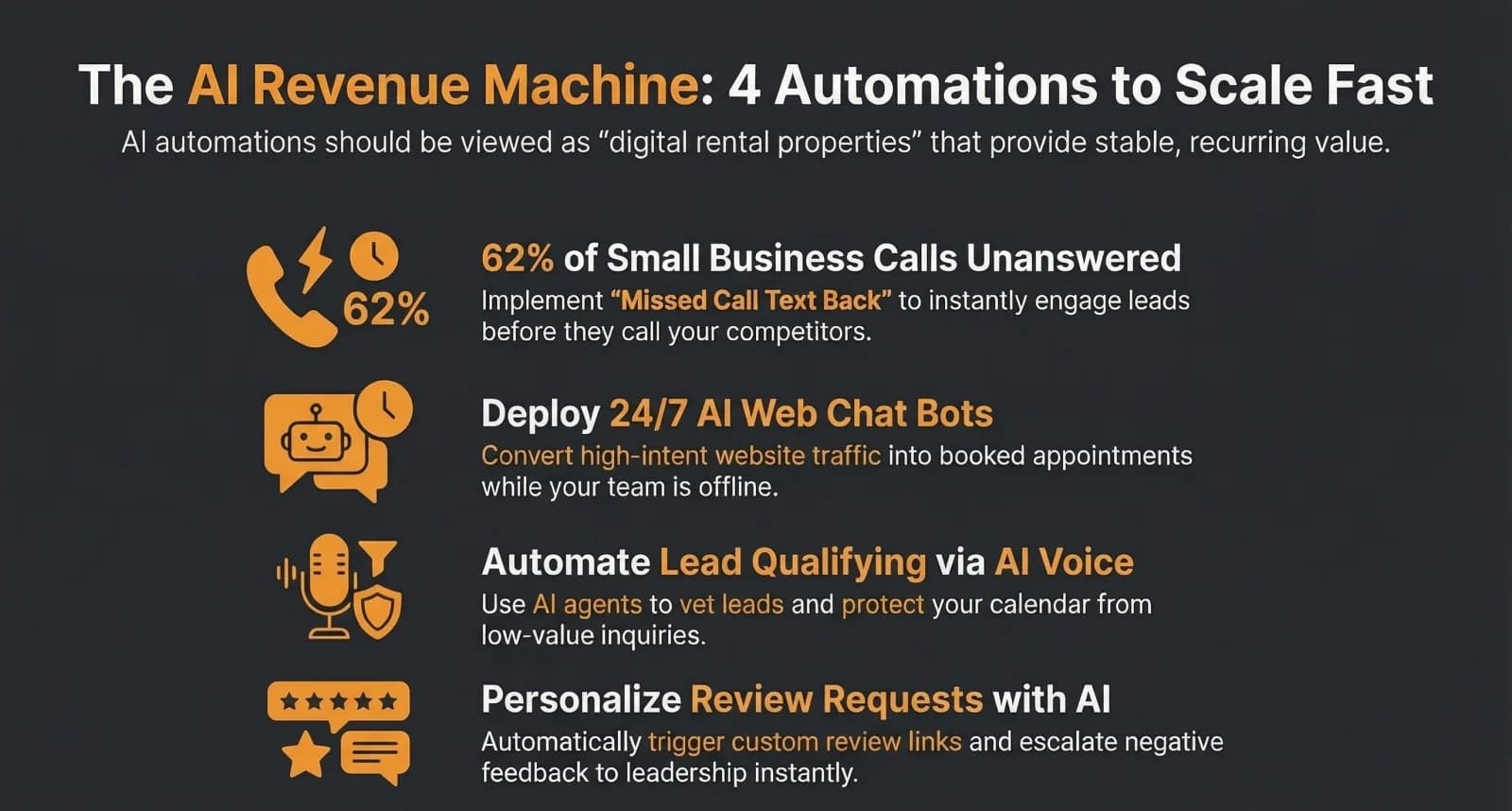
| Missed Call Text Back | Home Service Businesses (e.g., HVAC, Plumbing, Roofing, Landscaping) | GoHighLevel, Service Management Software (via API) | \$300 - \$500 per month; facilitates 3-4 additional jobs per month | Easy | Reduces lead loss; converts 62\% of unanswered calls; saves time for solo operators | Pitch the cost of missed opportunities by asking how they handle after-hours calls; highlight the 62\% industry average of unanswered calls. |
| AI Chat / Conversation Bot | Local Businesses, Car Dealerships, Remodeling, Fencing | GoHighLevel, Google Calendar, Web Crawler/Knowledge Base | \$500 - \$1,000 per month (often sold as a package) | Moderate | 24/7 lead collection; automated appointment booking; high-intent customer engagement | Demonstrate a live test drive of a bot trained on the client's own website during the sales call to show instant value. |
| Lead Qualifying / AI Voice Agent | High-volume Lead Gen Businesses (e.g., Fencing, Facebook Ad users) | Youratlas.com, CRM (GoHighLevel, HubSpot, Salesforce) | Increases closing rates (e.g., up to 50\%) by filtering low-quality leads | Moderate | Filters unqualified leads; saves sales team's time; automates data and phone number formatting | Frame the solution as an AI Employee that ensures the sales team only speaks with ready-to-buy customers. |
| LinkedIn / Outbound Messaging Agent | B2B, Content Creators, Coaching | LinkedIn, AI Writing Models (N8N, Custom Workflows) | \$1,200 setup fee; contributes to \$1\text{M}+ annual revenue | Moderate to High | Consistent inbound traffic; expands top-of-funnel reach; eliminates manual writing and research | Sell the destination (never having to write a post again) rather than the vehicle (the technical automation nodes). |
| AI Financial Dashboard / CFO Bot | SME Owners, Entrepreneurs | Hellofrank.ai, N8N, Make.com, Databox | Protects cash flow; identifies savings and insights worth thousands | High | Daily cash flow visibility; 92\% financial process automation; real-time metric tracking | Pitch as a fractional CFO that provides daily automated insights instead of waiting for delayed accountant reports. |
| Automated Onboarding & Support | SaaS, Service Agencies, Subscription Models | N8N, Make.com, Zapier, Customer Communities | Reduces churn by 50\%; doubles referral rates | High | Instant speed to value for new clients; automated smart nudges for disengaged users | Focus on the Buy Back Your Time principle, showing how automation handles 90\% of repetitive client management. |
| Content Multiplying / Repurposing | Companies with long-form video or podcasts | ChatGPT, Transcription tools, PSL Framework | High-margin fees for high-volume short-form content generation | Easy to Moderate | Generates leads on TikTok/Instagram from existing content; maintains consistent social presence | Offer to turn a single dead asset into a month's worth of viral potential with zero additional effort from the client. |
| AI Website Studio | New Businesses, Landing Page Needs | Lovable, Framer.com, ChatGPT | Scalable to \$10\text{M}/year businesses; monthly maintenance fees | Easy | Pixel-perfect responsive sites built in hours; automated feedback iterations via API | Sell the speed of deployment and the elimination of expensive developers/agencies for landing page creation. |
| AI Review Request Follow-up | Service Businesses with multiple locations | GoHighLevel, AI Agents, Field Management Software (via API) | Not in source | Moderate | Personalized review requests; intelligent routing to Google Business Profile; escalates negative feedback | Highlight the increase in local SEO rankings and trust by automating personalized, location-specific review generation. |
Original research by ManaTech
Frequently Asked Questions
What is the ROI of AI automation for small businesses?
AI automation for small businesses typically recovers 25-40 hours per week across the team and delivers measurable revenue impact within 30 days. Lead scoring alone increases close rates by 30%, and automated reporting saves 6 hours per week on data compilation. Most automations pay for themselves within the first quarter.
How long does it take to implement AI automation?
Each individual AI automation can be designed, built, and deployed in 2-4 weeks. You do not need to implement all five at once. Start with the one that addresses your biggest time drain, typically lead scoring or CRM follow-ups.
Which AI automation should a business implement first?
For most businesses, start with intelligent lead scoring if sales is the bottleneck, or CRM follow-up automation if deals are stalling in the pipeline. These two automations have the most direct revenue impact and can be deployed independently in 2-4 weeks.
Can AI automation replace employees?
AI automation is designed to multiply your team output, not replace people. It handles repetitive tasks like data compilation, follow-up drafting, and content reformatting so your team can focus on high-value work like closing deals and building client relationships.
How does AI content repurposing work?
AI content repurposing takes one piece of source content and transforms it into multiple platform-native formats simultaneously. A single article becomes LinkedIn posts, email newsletter segments, X threads, and short-form video scripts, each reformatted for its specific platform conventions.
Think You've Got It?
10 questions to test your understanding — instant feedback on every answer
Question 1 of 10
According to the source material, which three AI-driven automations are considered essential for a home service business to increase revenue?
Question 2 of 10
When selling AI services to a business owner, Nate Herk suggests focusing on the 'destination' rather than the 'vehicle'. What does this concept mean?
Question 3 of 10
Nate Herk identifies three core resources that business owners care about above all else. What are they?
Question 4 of 10
In Dan Martell's 'Content Multiplying' strategy, what does the 'PSL' framework stand for?
Question 5 of 10
What is the primary benefit of using an AI 'Voice Agent' like Atlas in the lead qualification process?
Question 6 of 10
To make an AI automation offer a 'no-brainer', what level of Return on Investment (ROI) does Nate Herk suggest you should demonstrate?
Question 7 of 10
How does Pavlo suggest training an AI chatbot so that it knows a client's specific business details (like hours, pricing, and services)?
Question 8 of 10
In the context of Dan Martell's financial automations, what is the 'Daily Cash Email' intended to solve?
Question 9 of 10
What does Ryan from Markinuity warn can happen if a business owner suddenly implements high accountability where there was none before?
Question 10 of 10
Which software 'mediators' are mentioned as tools to connect field management software (like Jobber or Housecall Pro) to AI platforms?
Related Content
Building an AI Employee: Custom Applications That Replace Repetitive Tasks
How custom-built AI systems act as digital employees, handling meeting notes, inbox management, analytics, and onboarding so your team can focus on growth.
Read more →blogWhen Should You Outgrow Zapier and Build a Custom Automation System?
Zapier is the right tool until it is not. When your automation bill exceeds $500-1,000 per month, workflows break at critical moments, or you need logic that a visual builder cannot express, it is time to consider a custom automation system. One company went from $600 per month on Zapier to $75 per month with a custom build.
Read more →blogHow to Build AI Agents for Your Business Without Writing Code
AI agents go beyond chatbots — they take actions, make decisions, and complete multi-step workflows autonomously. IDC expects AI copilots embedded in 80% of enterprise apps by 2026. Here is how to build your first AI agent without code.
Read more →blogAI Voice Agents for Business: The Complete 2026 Guide
AI voice agents handle inbound calls, qualify leads, and book appointments 24/7 — without hiring staff. This guide covers what they are, what they cost, and how to deploy one for your business.
Read more →blogHow to Measure the ROI of AI Automation in Your Business
AI automation delivers measurable returns in 90-180 days when scoped correctly — but 95% of AI projects fail because businesses skip baseline measurement. Here is a practical framework for measuring AI ROI across efficiency, revenue, and cost reduction.
Read more →Want to explore this topic further?
Book a free discovery call to discuss how ManaTech can help your business implement these ideas.
Book a Discovery Call