
How AI Skills Are Replacing SOPs for Small Businesses
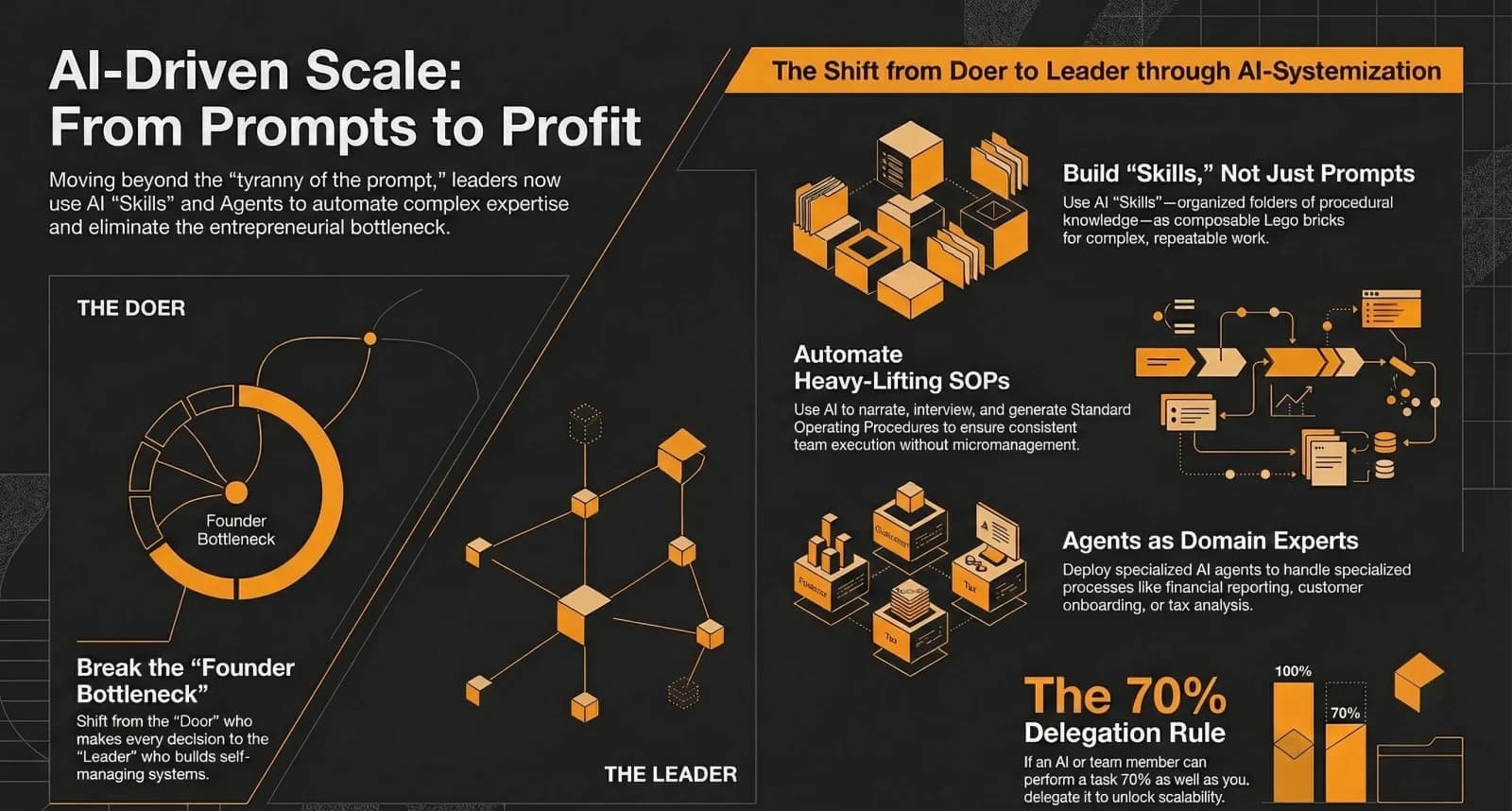
Quick Answer
AI skills are modular markdown instruction files that turn static SOPs into executable, version-controlled AI workflows. Unlike traditional SOPs that just describe what should happen, AI skills are read and followed step by step by an AI assistant, handling execution, error recovery, and quality checks automatically, and they improve every time they run.
Key Answers
- What are AI skills?
- AI skills are modular markdown instruction files stored in your project repository that an AI assistant reads and executes step by step, replacing static SOPs with active, self-improving workflows.
- Why do traditional SOPs fail small businesses?
- SOPs are static documents that describe what should happen but do not execute anything. They depend on someone reading, interpreting, and manually following steps, and they rarely get updated.
- What is progressive disclosure in AI skills?
- Progressive disclosure reveals information in layers: trigger, process, and knowledge. The AI loads reference material only when needed for a specific step, keeping it focused and efficient.
- What business processes can become AI skills?
- Almost any repeatable process: client onboarding, content pipelines, code review, deployment, inventory management, report generation, and supplier communications.
- Can AI skills improve themselves over time?
- Yes. Skills 2.0 introduces A/B testing, regression detection, and three-level scoping. Every improvement is tracked, reviewable, and reversible through version control.
Key Takeaways
- AI skills are version-controlled markdown files that an AI assistant reads and executes step by step, replacing static SOPs that describe processes but do not actually perform them.
- Progressive disclosure architecture keeps AI skills efficient by revealing information in layers: trigger, process, and knowledge, loading reference material only when needed for a specific step.
- AI skills are composable, meaning a client onboarding skill can call a project setup skill, which calls a repository initialization skill, creating modular, testable, reusable process components.
- Skills 2.0 features include A/B testing for processes, regression detection, and three-level scoping: project-scoped, organization-scoped, and personal, allowing standardized processes with individual customization.
- Practical use cases extend beyond software development to marketing content pipelines, client onboarding workflows, inventory management, and any repeatable business process that currently lives in someone's head or in outdated documentation.

Why Do Traditional SOPs Fail Small Businesses?
Traditional SOPs are static documents that describe what should happen but do not execute anything. They depend on manual interpretation, rarely get updated, and break when the person who knows the process is unavailable.
Every small business has processes. Onboarding a new client. Deploying a code update. Generating a monthly report. Processing a refund. But in most SMBs, these business processes live in one of three places: a Google Doc nobody has updated in two years, the head of the person who usually does it, or nowhere at all. When that person is sick, on holiday, or leaves, the process breaks. Traditional SOPs have a fundamental flaw: they are static documents. They describe what should happen but do not actually do anything. Someone still has to read, interpret, and execute manually. When the process changes, someone has to remember to update the document. In practice, they rarely do.
What Are AI Skills?
AI skills are modular markdown instruction files that an AI assistant reads and executes step by step. They handle prerequisites, commands, file creation, output validation, and error recovery automatically.
AI skills are modular markdown instruction files that turn business processes into executable AI workflows. Unlike a static SOP, a skill is a living document that an AI assistant reads and follows step by step. When you invoke a skill, the AI executes the instructions: checking prerequisites, running commands, creating files, validating outputs, and handling errors. Skills are stored as simple markdown files in your project repository. They are version-controlled, reviewable, and collaborative. Each skill has a clear trigger, a defined process, and embedded knowledge. Think of it as the difference between a recipe printed on paper and a robot chef that reads the recipe and cooks the meal.
How Does Progressive Disclosure Work in AI Skills?
Progressive disclosure reveals skill information in three layers: trigger, step-by-step process, and reference knowledge. The AI loads detailed material only when needed for a specific step, keeping context focused.
The most effective AI skills use a design pattern called progressive disclosure. Instead of loading the entire process into the AI context at once, the skill reveals information in layers. The first layer is the trigger: a short description of when this skill should activate. The second layer is the process: step-by-step instructions the AI follows sequentially. The third layer is knowledge: reference material, templates, and examples loaded only when needed. This architecture keeps the AI focused on the current step while having access to deep context when required. It also makes skills composable. A client onboarding skill might call a project setup skill, which calls a repository initialization skill. Each skill handles its own scope and passes results up the chain.
What Business Processes Can Become AI Skills?
Almost any repeatable process can become an AI skill. Common examples include content pipelines, client onboarding, code review, deployment workflows, inventory management, and supplier communications.
The applications extend far beyond software development. A marketing agency can encode its content pipeline as a skill: briefing intake, keyword research, draft generation, review checklist, and publishing workflow. A professional services firm can create a client onboarding skill that generates welcome documents, sets up project folders, and schedules kickoff meetings. An e-commerce business can build an inventory management skill that monitors stock levels and drafts supplier communications. Code review checklists become skills that check for security vulnerabilities and coding standards. Deployment workflows become skills that run tests, deploy to staging, verify functionality, and promote to production. Each replaces a static document with an active, intelligent process.
What Is New in Skills 2.0?
Skills 2.0 introduces A/B testing for processes, regression detection for quality drops, and three-level scoping: project, organization, and personal. Every change is tracked through version control.
The next generation of AI skills introduces capabilities that make them genuinely self-improving. A/B testing allows you to run two versions of a process side by side and measure which produces better outcomes. Regression detection flags when a skill starts producing lower-quality results, often because upstream data or tools have changed. Skills can now be scoped at three levels. Project-scoped skills live in the repository and travel with the codebase. Organization-scoped skills are shared across all projects and team members. Personal skills capture individual preferences and workflows. This layered scoping means a business can standardize core processes while allowing individual customization.
What Is the Bottom Line?
AI skills turn tribal knowledge into reliable, repeatable, self-improving systems. Start with your most painful process and encode it as a markdown skill file. Most businesses see ROI within the first week.
You do not need to replace all your SOPs at once. Start with your most painful process: the one that breaks most often or depends on a single person. Write it as a markdown skill file with clear steps, expected inputs, and quality checks. Test it with your AI assistant and iterate. Most businesses find that their first skill pays for itself within the first week. At ManaTech, we build AI skills into every client engagement. We also help clients encode their own business processes as AI skills, turning tribal knowledge into reliable, repeatable, self-improving systems.
Research Data
Key strategies and factors based on original research
| Concept or Strategy | Domain / Category | Key Metrics or Statistics | Practical Application | Primary Benefits | Expert / Source Entity |
|---|---|---|---|---|---|
| AI Adoption Spectrum (15/70/15 Split) | Business Strategy / AI Adoption | 15% leading edge (embracing), 70% middle (interested but unsure), 15% resistant (view AI as evil). | Used by leaders to identify where their organization and community sit in the adoption curve to set precedents. | Helps organizations avoid suffering from being left behind by a fundamental shift in business operations. | Jonathan Mast (Whitebeard Strategies) |
| Scaling Plateau (The $3M Stall) | Business Growth / Statistics | High percentage of companies stall at $3M and disappear within 5-10 years if they lack self-managing teams. | Shift from $1M-$3M growth to building a team that runs without the owner to avoid the stall. | Enables the business to survive and continue growing without the owner being the functional bottleneck. | Troy & Trevor (SoTellUs) |
| SOP Implementation Outcomes | Operations / Business Growth | 75% of key processes updated within a few weeks using AI-assisted documentation. | Narrating or interviewing staff to have AI distill concepts into step-by-step procedures in relevant formats. | Increased team bandwidth; creates repeatable, predictable results and prevents business breakdown during 10x scaling. | Jonathan Mast (Whitebeard Strategies) |
| 70% Rule for Delegation | Team Management / Scaling | If a team member can do a task 70% as well as the leader, it should be delegated. | Leaders use this as a threshold to move from 'doer' to 'manager' to 'leader' by empowering staff with authority. | Removes the owner as the bottleneck, allowing for business scalability beyond personal capacity. | Troy & Trevor (SoTellUs) |
| AI Skills vs. Agents | Technical Framework / AI Architecture | Skills: organized folders of procedural knowledge; Agents: universal interface often using code/bash/file systems. | Build composable 'skills' (folders with scripts/markdown) that any agent can use rather than rebuilding agents for every use case. | Solves the 'domain expertise' gap; skills are modifiable, versionable in Git, and protect the context window via progressive disclosure. | Barry Zhang & Mahesh Murag (Anthropic) |
| Model Context Protocol (MCP) | Technical Framework | Standard for agent connectivity; provides connection to the outside world. | Orchestrates workflows of multiple tools stitched together with external data and connectivity. | Provides the infrastructure for agents to interact with third-party software and enterprise data effectively. | Barry Zhang & Mahesh Murag (Anthropic) |
| Self-Managing Team Framework | Management | 3 essential systems: Documented processes (SOPs), Decision-making guidelines, and Defined roles. | Teaching employees to bring solutions, not just problems, and using scorecards/KPIs for accountability. | Eliminates owner burnout and creates a business that makes money while the owner is on vacation. | Troy & Trevor (SoTellUs) |
| Super Prompts (Composable Lego Bricks) | AI Prompt Engineering | 10X lever on prompting; reduces the need for lengthy, exhaustive detail in every chat session. | Using zip files containing markdown instructions and assets that can be uploaded to Claude, ChatGPT, or Gemini. | Enables complex, multi-step work (like full financial analysis) with significantly less manual effort. | Nate B. Jones |
Original research by ManaTech
Frequently Asked Questions
What are AI skills and how are they different from SOPs?
AI skills are modular markdown instruction files stored in your project repository that an AI assistant reads and executes step by step. Unlike traditional SOPs, which are static documents someone must read and manually follow, AI skills handle execution, error recovery, and quality validation automatically. They are version-controlled, composable, and improve over time.
How do I create an AI skill for my business?
Start with your most painful process, the one that breaks most often or depends on a single person. Write it as a markdown file with clear steps, expected inputs, and quality checks. Use progressive disclosure by organizing the skill into a trigger section, a step-by-step process, and reference knowledge loaded only when needed. Test it with your AI assistant and iterate.
What is progressive disclosure in AI skills?
Progressive disclosure is a design pattern where the skill reveals information in layers rather than loading everything at once. The first layer is the trigger describing when to activate. The second is the step-by-step process. The third is reference material and templates loaded only for specific steps. This keeps the AI focused while having access to deep context when required.
What kinds of business processes can be turned into AI skills?
Almost any repeatable process can become an AI skill. Common examples include client onboarding, content creation pipelines, code review checklists, deployment workflows, inventory management, report generation, and supplier communications. If a process currently lives in a Google Doc or in someone's head, it is a candidate for an AI skill.
Can AI skills improve themselves over time?
Yes. Skills 2.0 introduces A/B testing to compare process versions, regression detection to flag quality drops, and three-level scoping for project, organization, and personal use. Because skills are version-controlled markdown files, every improvement is tracked, reviewable, and reversible, creating a system that genuinely strengthens with each execution.
Think You've Got It?
10 questions to test your understanding — instant feedback on every answer
Question 1 of 10
According to Jonathan Mast, what is the primary philosophy regarding the relationship between AI and human skill?
Question 2 of 10
Jonathan Mast identifies three groups of business leaders regarding AI adoption. Which group represents approximately 70% of the market?
Question 3 of 10
In the context of building a self-managing team, what is described as the main problem for business owners who become a 'bottleneck'?
Question 4 of 10
According to the 'SoTellUs' transcript, what are the three essential systems needed for a team to self-manage?
Question 5 of 10
What is the '70% rule' mentioned in the context of delegation?
Question 6 of 10
Why do many companies that reach 3$ million in revenue frequently stall or disappear?
Question 7 of 10
In the Anthropic presentation, Barry Zhang and Mahesh Murag suggest shifting from 'building agents' to doing what instead?
Question 8 of 10
What is the relationship between MCP (Model Context Protocol) and 'Skills' in the emerging AI architecture?
Question 9 of 10
Nate B Jones describes Claude's new 'Skills' feature as a way to get past which common AI challenge?
Question 10 of 10
When should an entrepreneur choose to create a 'Skill' rather than just writing a standard prompt?
Related Content
How to Measure the ROI of AI Automation in Your Business
AI automation delivers measurable returns in 90-180 days when scoped correctly — but 95% of AI projects fail because businesses skip baseline measurement. Here is a practical framework for measuring AI ROI across efficiency, revenue, and cost reduction.
Read more →blog5 AI Quick Wins Any Business Can Implement This Quarter
You do not need a six-figure budget or a data science team to start using AI. These five practical automations can be running inside your business within weeks — saving 15-30 hours per month and paying for themselves in the first quarter.
Read more →blog5 Revenue-Generating AI Automations Every Growing Business Needs
Five high-ROI AI automations that directly impact revenue, from intelligent lead scoring to automated analytics reporting. Each one pays for itself within weeks.
Read more →blogWhat Is an AI Operating System and Why Does Every SMB Need One?
Most businesses using AI are still bolting on individual tools one at a time. An AI Operating System flips the model: context first, integrations second, automations built on top. The result is a business that runs on AI instead of just using it.
Read more →blogAI for NZ Accountants: The Practitioner’s Guide to 2026
New Zealand accounting practices run on Xero, MYOB, and a 31 March financial year. The AI tools built for US firms ignore those constraints. This is the practical guide for NZ practitioners — what to automate first, which integrations matter, and what an AI-powered practice actually costs to build in 2026.
Read more →Want to explore this topic further?
Book a free discovery call to discuss how ManaTech can help your business implement these ideas.
Book a Discovery Call