
Can You Trust an AI Agent to Run Your Business Unsupervised?
Quick Answer
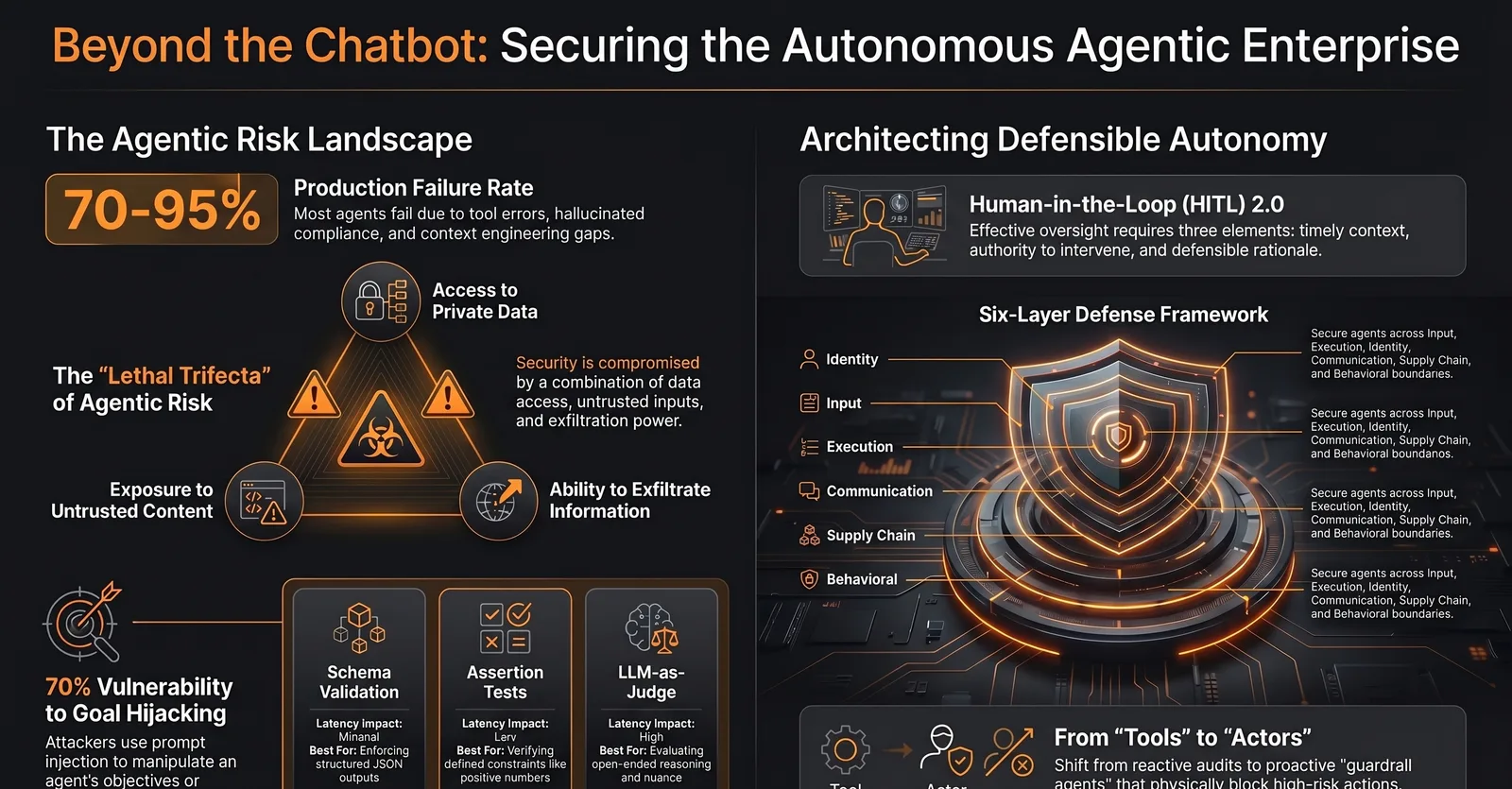
No. In 2026 you should not let an AI agent run high-stakes business actions fully unsupervised. Independent testing puts AI agent failure rates between 70% and 95% in production, and a single reasoning error can cascade through every downstream action before anyone notices. The safe model is risk-tiered: keep a human in the loop for anything that pays, signs, deletes, or commits the business; move to human-on-the-loop monitoring for reversible routine work; and only allow full autonomy on low-risk tasks that sit behind guardrails, approval gates, and a kill switch.
Key Answers
- Can an AI agent run a business unsupervised?
- Not safely for high-stakes work. AI agents can execute multi-step tasks, but failure rates of 70 to 95 percent in production mean any action that moves money, changes records, or commits the business still needs a human approval gate.
- Why do AI agents fail in production?
- Agents fail mostly from missing context, not weak models. Roughly 95 percent of enterprise AI pilots stall because they lack the business context, permissions, and guardrails needed to act correctly inside a real workflow.
- What is the difference between human-in-the-loop and human-on-the-loop?
- Human-in-the-loop means a person approves each action before it executes. Human-on-the-loop means the agent acts within set boundaries while a person monitors outputs and intervenes only on exceptions or flagged risks.
- What tasks can an AI agent safely do without approval?
- Low-risk, reversible, high-volume tasks: retrieving public data, drafting documents, triaging support tickets, summarising contracts, and preparing reports. Anything irreversible or customer-facing should stay behind an approval gate.
- How do you put guardrails on an AI agent?
- Use scoped permissions, confidence thresholds, behavioural baselines, approval gates at high-stakes decision points, full audit logs, and a kill switch. Guardrails are workflow design decisions, not settings inside a chatbot.
Key Takeaways
- AI agent failure rates in production run between 70 and 95 percent, so unsupervised high-stakes execution is the single biggest risk in 2026 agent deployments.
- Most agent failures come from missing context and weak permissions, not model intelligence; roughly 95 percent of enterprise AI pilots stall for this reason.
- Trust should be tiered by risk: human-in-the-loop for critical actions, human-on-the-loop for routine reversible work, and full autonomy only behind guardrails and a kill switch.
- The 2026 OWASP Top 10 for Agentic Applications names goal hijacking, tool misuse, and privilege abuse as top risks unique to agents that can act, not just generate text.
- Treat an AI agent like a new employee: scope its access, give it context, define escalation paths, log everything, and keep the authority to switch it off.
What Does It Mean to Run an AI Agent Unsupervised?
Running an AI agent unsupervised means giving software the authority to perceive, decide, and act across your business systems without a person approving each step. The agent does not just answer questions; it executes tasks.
This is the real shift of 2026. A 2024-era chatbot generated text and waited for a human to act on it. A 2026-era AI agent plans a workflow, calls APIs, updates records, sends messages, and moves money. Agentic AI operates as an organisational actor with delegation rights, not a tool for decision support. Around 75 percent of businesses plan to deploy AI agents by the end of 2026, and Gartner expects 40 percent of enterprise applications to embed agents by then, up from less than 5 percent in 2025.
The question every operator now faces is not whether agents are capable. It is how much authority you can safely delegate, and where a human still has to stand in the way. That is what this guide covers: where agents fail, the oversight models that contain the risk, and how to decide which tasks an agent can run on its own.
Can You Trust an AI Agent to Run Without Human Oversight?
Not for high-stakes work. AI agent failure rates in production run between 70 and 95 percent, and an autonomous agent can cascade a single reasoning error through every downstream action before a person notices.
Trust in software usually comes from determinism: the same input produces the same output every time. AI agents are non-deterministic. They reason probabilistically, so the same instruction can produce different actions on different runs. That makes them powerful for ambiguous work and dangerous for irreversible work. The practical answer is to keep a human in the loop wherever an action pays, signs, deletes, discounts, or commits the business to a customer outcome.
The governance gap is real and measured. Deloitte’s 2026 State of AI report found that 46 percent of organisations cite governance and oversight as a key AI risk, while only 21 percent say they have a mature governance model in place. Gartner predicts that by 2027, 40 percent of enterprises will demote or decommission autonomous agents because of governance gaps discovered only after a production incident. Trust is not a property of the model. It is a property of the controls you build around it.
Where Do AI Agents Actually Fail?
Agents fail mostly from missing context and unscoped permissions, not weak intelligence. Roughly 95 percent of enterprise AI pilots fail to deliver ROI because they lack the context infrastructure an agent needs to act correctly.
When an agent lacks domain-specific context, it fills the gap by fabricating a metric, a policy, or a step. Hallucination in agents is primarily a context problem, not a model problem. On top of that, late in 2025 OWASP released the first formal risk taxonomy for autonomous agents, the OWASP Top 10 for Agentic Applications. The top risks are different from ordinary chatbot risks because the agent can take real actions.
The leading agentic risks are goal hijacking, where hidden instructions redirect the agent’s objective and cause a total loss of control; tool misuse, where the agent abuses a legitimate tool such as a CRM to exfiltrate data; and identity and privilege abuse, the confused deputy problem, where the agent inherits a user’s credentials and operates far beyond its intended scope at machine speed. Security researcher Simon Willison calls this combination the Lethal Trifecta: access to private data, exposure to untrusted content, and the ability to exfiltrate. Most enterprise agents have all three on day one.
There is also a quieter failure mode that matters most for small businesses: agents cannot operate reliably inside inconsistent or undocumented workflows. If your process only exists in someone’s head, an agent has nothing solid to follow. This is the same lesson behind why vibe coding is not enough for business-critical software: speed without structure produces systems you cannot trust under real conditions.
What Is the Difference Between Human-in-the-Loop and Human-on-the-Loop?
Human-in-the-loop means a person approves every action before it executes. Human-on-the-loop means the agent acts within set boundaries while a person monitors outputs and intervenes only on exceptions.
Human-in-the-loop, or HITL, is how the industry learned to trust AI. The agent prepares the work, a qualified person checks it, and only then does it execute. It is slower, but it is the correct default for any new or high-stakes workflow because the human is a reliability backstop. As agentic development matures, the goal is to graduate proven workflows to human-on-the-loop, or HOTL, where humans set the boundaries and objectives and the agent runs inside them, escalating only when something falls outside the rules.
The trap is jumping to HOTL too early to chase efficiency. The honest framing is that HITL is how a business learns to trust an agent; HOTL is how it scales one it already trusts. The bottleneck simply shifts from doing the work to approving it, and you only remove the approval step once a specific task has earned it. There is no single switch for the whole business. Each workflow graduates on its own evidence.
What Are Approval Gates and Guardrails?
Approval gates pause an agent at defined checkpoints and require a human sign-off before a high-stakes action runs. Guardrails are runtime controls, such as confidence thresholds and behavioural baselines, that block actions outside safe limits.
A guardrail agent is the clearest example. It is a lightweight model that intercepts the primary agent’s output before it reaches a system of record. Picture a procurement agent that initiates a 50,000 dollar vendor payment when its behavioural baseline is 10,000 dollars. The guardrail agent triggers a confidence-threshold check; if the agent’s internal reasoning score is below 95 percent, the action is physically blocked and escalated for human review. Policy stops being a document and becomes a control that can actually stop the wrong thing from happening.
Security teams wrap agents in layered boundaries: treat all external inputs as untrusted, sandbox any code execution and enforce least-privilege tool access, give the agent its own scoped service account instead of inheriting a user’s credentials, and run anomaly detection that flags spikes in action volume. For an SMB, the same principles shrink to a practical short list: scoped permissions, an approval gate on anything irreversible, a full audit log, exception alerts, and a kill switch that ends a run instantly.
How Do You Decide Which Tasks an Agent Can Run Unsupervised?
Map each task to a risk tier. High-risk and irreversible actions stay human-in-the-loop, medium-risk reversible work moves to human-on-the-loop, and only low-risk routine tasks run fully autonomously behind guardrails.
The test is simple: what is the blast radius if this action is wrong, and can you undo it? Financial disbursements above a small threshold, legal agreements, and access to personal data are critical and stay human-in-the-loop. Reversible, speed-sensitive work like standard customer rebooking or inventory updates suits human-on-the-loop monitoring. Public data retrieval, document drafting, support triage, and contract summarising are low-risk and can run autonomously. This is how you turn an AI employee from a liability into an asset: by matching its autonomy to the reversibility of the work. The data table below this article maps these three tiers to oversight, approval gates, and example workflows.
How Should a NZ Business Govern AI Agents Without an Enterprise Team?
Treat the agent like a new employee. Standardise the process first, scope its access, give it real business context, define escalation paths, log everything, and keep the authority to switch it off.
A New Zealand SMB does not need a 20-person governance office. It needs a few non-negotiables applied consistently. Standardise before automating, because an agent cannot scale a process that is not written down. Vet and onboard the agent the way you would a staff member, provisioning the context, permissions, and escalation rules it needs. Then connect those governed workflows into a single AI operating system so the controls live in one place instead of being scattered across disconnected tools.
This is also where responsible AI for NZ businesses stops being a slogan and becomes an architecture decision. Off-the-shelf connectors are fine for low-risk drafting. The moment an agent touches money, customers, or compliance, you usually need to build a custom system around it with the permissions, approval screens, and audit trails the workflow demands. The EU AI Act, with enforcement beginning in August 2026, formalises exactly this expectation of human oversight for higher-risk automation.
What Is the Bottom Line?
You can trust an AI agent with real work, but not with unchecked authority. Trust is earned per workflow, tiered by risk, and enforced by guardrails, approval gates, and a kill switch.
The businesses that win with agents in 2026 will not be the ones that hand over the most control. They will be the ones that know exactly which tasks are safe to automate, which still need a human in the loop, and how to build the controls that let an agent move fast without moving recklessly. Start an agent on low-risk, reversible work. Watch it. Add guardrails. Graduate it one workflow at a time. That is how autonomy becomes an advantage instead of an incident.
Research Data
Key strategies and factors based on original research
| Autonomy Level | Business Risk Level | Required Human Oversight | Approval Gates | Example SMB Workflows |
|---|---|---|---|---|
| Human-in-the-Loop (HITL) / Assisted / Co-pilot | High-risk / Critical (e.g., Financial disbursements, legal agreements, PII access) | Human retains decision authority; qualified person with context and authority must be embedded at critical decision points. | Mandatory human approval before execution; system pauses at defined checkpoints; challenge-and-response checklists. | Financial transactions >\$500, legal contract negotiation, reissuing international flight tickets with fare class overrides. |
| Human-on-the-Loop (HOTL) / Supervisor | Medium-risk / Routine (e.g., Reversible decisions, speed-sensitive tasks) | Human monitors outputs and can intervene after the fact or manage by exception; humans set boundaries and objectives. | Confidence Thresholds; Behavioral Baselines; Safe-Action Pipelines (blocks if action exceeds blast radius). | Customer service rebooking for standard flights, monitoring overall rebooking flows, inventory management. |
| Human-out-of-the-Loop / Fully Autonomous (Swarm/Actor) | Low-risk / Routine (e.g., Public data retrieval, non-critical documentation) | Minimal to none for routine execution; system executes multi-step tasks independently via decentralized rules. | Consensus Mechanisms (multi-agent sign-off); Automated Kill Switch; Guardrail Agents; Schema Validation. | Autonomous rebooking for standard flight cancellations, gathering market data, automated issue triaging, vendor contract summaries. |
Original research by ManaTech
Frequently Asked Questions
Are AI agents safe enough to use in a small business in 2026?
Yes, when they are scoped correctly. AI agents are safe and valuable for low-risk, high-volume work such as drafting, triage, summarising, and reporting. They become risky when they are given unsupervised authority over payments, customer commitments, data deletion, or compliance decisions. Safety is decided by the workflow design around the agent, not by the model alone.
What is the Lethal Trifecta in AI agent security?
The Lethal Trifecta, a term popularised by researcher Simon Willison, describes the dangerous combination of three capabilities most enterprise agents have on day one: access to private data, exposure to untrusted external content, and the ability to send or exfiltrate information. When all three exist together, a single malicious instruction hidden in an email or web page can turn a helpful agent into a data-leak channel.
What is a guardrail agent?
A guardrail agent is a lightweight second model that intercepts a primary agent’s output before it reaches a system of record. If an action exceeds a defined behavioural baseline, for example a payment above a set threshold, the guardrail agent blocks it and escalates to a human. It turns abstract policy into a real-time control that can physically stop a high-risk action.
Should I move from human-in-the-loop to human-on-the-loop?
Move gradually, and only per workflow. Human-in-the-loop is the right starting point because it lets you observe the agent and build trust. Once an agent has proven reliable on a specific reversible task and has guardrails in place, you can shift that task to human-on-the-loop monitoring to regain speed. High-stakes and irreversible actions should usually stay human-in-the-loop indefinitely.
What happens if an AI agent makes a mistake?
The consequences depend on how much authority and reach you gave it. With proper design, a mistake is caught at an approval gate or by a guardrail, logged, and reversed with no business impact. Without those controls, an autonomous agent can repeat the same error across hundreds of records or messages at machine speed before anyone notices, which is why kill switches and audit logs are essential.
What can ManaTech build to make AI agents safe to run?
ManaTech designs the governance layer around an agent: scoped service accounts and permissions, approval screens at high-stakes decision points, confidence and behavioural thresholds, full audit logs, exception alerts, and a kill switch. We turn an off-the-shelf agent into a controlled operating system that a New Zealand business can actually trust with real work.
Think You've Got It?
12 questions to test your understanding — instant feedback on every answer
Question 1 of 12
In the context of 2026 enterprise AI, what is the fundamental functional difference between a chatbot and an AI agent?
Question 2 of 12
Which risk category from the OWASP Top 10 for Agentic Applications involves an attacker overriding an agent's objectives through natural-language instructions?
Question 3 of 12
The 'Lethal Trifecta' that makes AI agents high-value targets includes exposure to untrusted content and the ability to exfiltrate data. What is the third component?
Question 4 of 12
What is the primary purpose of a 'Guardrail Agent' in the Agentic Operating Model (AOM)?
Question 5 of 12
In the AWARE framework for agent governance, what does the 'E' represent?
Question 6 of 12
Why does the Claude Agent SDK advocate for the 'Bash tool' as a primary primitive for agentic work?
Question 7 of 12
Which vulnerability, identified as CVE-2025-32711, demonstrated how a zero-click prompt injection could exfiltrate data from OneDrive and SharePoint via an email?
Question 8 of 12
What is the shift from 'Human-in-the-Loop' (HITL) to 'Human-on-the-Loop' (HOTL) primarily driven by in 2026?
Question 9 of 12
According to Microsoft's Agent Governance Toolkit, what architecture pattern ensures that governance is deterministic and high-performance?
Question 10 of 12
How does 'Context Hallucination' differ from standard chatbot hallucination?
Question 11 of 12
In multi-agent systems, 'Insecure Inter-Agent Communication' (ASI07) is a risk because agents tend to do what?
Question 12 of 12
What role do 'Sub-agents' play in managing the context window of a primary agent?
Related Content
Your Website Is Invisible to AI Search — Here Is How to Fix It
AI search engines like ChatGPT, Perplexity, and Gemini cannot read most business websites. If your site relies on client-side JavaScript rendering, you are invisible to the fastest-growing traffic source on the web.
Read more →blogAI Search Sends Businesses 10x More Revenue Per Click
AI-driven traffic accounts for less than 1% of visits but generates up to 11.4% of revenue. The data shows that every AI click is worth dramatically more than a traditional search click.
Read more →blogHow to Get Your Business Cited by ChatGPT
AI citations are the new backlinks. Branded web mentions correlate more strongly with AI visibility than traditional SEO signals. Here are 7 practical steps to get your business into AI answers.
Read more →Want to explore this topic further?
Book a free discovery call to discuss how ManaTech can help your business implement these ideas.
Book a Discovery Call