
How to Get Your Business Cited by ChatGPT
Quick Answer
Getting cited by ChatGPT and other AI search engines requires a fundamentally different approach than traditional SEO. Branded web mentions now correlate more strongly with AI visibility than backlinks, and the 7 key steps include creating comparison content, building presence on Reddit and Quora, producing YouTube content, keeping content fresh, using BLUF formatting, structuring semantic triples, and implementing FAQ schema.
Key Answers
- Why are AI citations more valuable than backlinks?
- Branded web mentions correlate more strongly with AI visibility than traditional backlink profiles. Each AI citation drives direct traffic and reinforces your authority in the model.
- Do different AI platforms use the same sources?
- No. Research shows 86% of sources cited by AI platforms are unique to that platform. You need a multi-platform content strategy covering ChatGPT, Perplexity, and Gemini.
- How important is content freshness for AI search?
- Content cited by AI models is 25.7% fresher on average than content ranking in traditional search. Updating content quarterly improves citation likelihood significantly.
- What is the fastest way to test my AI visibility?
- Ask ChatGPT, Perplexity, and Gemini to recommend businesses in your category. If your brand does not appear, you need to optimize your content and technical setup.
- What are the biggest AI optimization mistakes?
- Treating it like traditional SEO with keyword stuffing, accidentally blocking AI crawlers in robots.txt, and relying only on your own website instead of building cross-platform presence.
Key Takeaways
- AI citations are the new backlinks, with branded web mentions correlating more strongly with AI search visibility than traditional backlink profiles.
- 86% of sources cited by AI platforms are unique to that platform, meaning a page cited by ChatGPT may never appear in Perplexity answers, requiring a multi-platform content strategy.
- Content freshness matters 25.7% more in AI search than traditional SEO, creating an opportunity for smaller brands to outrank established competitors who sit on stale content.
- BLUF (Bottom Line Up Front) formatting, where you place the direct answer in the first paragraph, significantly increases the likelihood of AI citation across all major platforms.
- Building presence across forums like Reddit and Quora, creating YouTube content, and publishing comparison pages are among the highest-impact tactics because AI models weight diverse source types.
Why Are AI Citations More Valuable Than Backlinks?
Branded web mentions now correlate more strongly with AI visibility than traditional backlink profiles. Each AI citation drives direct traffic and reinforces your brand authority in the model.
For two decades, backlinks were the currency of search visibility. The more authoritative sites that linked to you, the higher you ranked. AI search has introduced a new currency: citations. When ChatGPT, Perplexity, or Gemini mention your business in an answer, that citation drives direct traffic and reinforces your brand authority in the model. Research shows that branded web mentions correlate more strongly with AI visibility than traditional backlink profiles. Your strategy needs to shift. Instead of chasing links from high-domain-authority sites, ensure your brand appears in the contexts where AI models look for answers. Each AI-referred click generates 10x more revenue than traditional search, making early citation-building one of the highest-leverage investments a business can make.
What Does Each AI Platform Prefer as Sources?
Each AI platform sources information differently. 86% of cited sources are unique to one platform, so you need a multi-platform content strategy covering ChatGPT, Perplexity, and Gemini.
Not all AI platforms source information the same way. ChatGPT relies heavily on Bing-based search integration and favors well-structured, recently updated content. Perplexity pulls from a broader set of sources and weights academic-style citations and data-rich content. Gemini leans on Google search results but applies its own relevance scoring. Here is the critical insight: 86% of sources cited by AI platforms are unique to that platform. A page that ChatGPT cites may never appear in a Perplexity answer. You cannot optimize for just one AI search engine. You need content that satisfies the different retrieval patterns of each major platform.
How Important Is Content Freshness for AI Search?
Content freshness matters 25.7% more in AI search than in traditional SEO. Consistently publishing updated, data-driven content helps smaller brands outrank established competitors with stale pages.
Content freshness matters significantly more in AI search than in traditional SEO. Content cited by AI models is 25.7% fresher on average than content ranking in traditional search. AI systems prioritize recently published or updated content because they aim to give current answers. This creates both a challenge and an opportunity. Your evergreen content will decay faster in AI search visibility. But consistently publishing fresh, data-driven content can help a smaller brand outrank established competitors sitting on stale content. If you published a comprehensive guide six months ago, update it with current statistics and recent examples. The update signal alone can improve your citation likelihood across all major AI platforms.
What Are the 7 Practical Steps to Get Cited by AI?
The seven steps are: create comparison content, build Reddit and Quora presence, produce YouTube content, update pages quarterly, use BLUF formatting, structure semantic triples, and implement FAQ schema.
First, create comparison content. Pages that compare tools, services, or approaches are among the most frequently cited by AI models. Second, build presence on Reddit and Quora. AI models heavily weight discussion forums as signals of genuine user sentiment. Third, produce YouTube content. Video transcripts are indexed by AI systems, and YouTube is a primary source for several platforms. Fourth, keep content fresh by updating existing pages with new data at least quarterly. Fifth, use BLUF formatting. Put the direct answer in the first paragraph with supporting detail below. Sixth, structure your content using semantic triples: clear subject-predicate-object statements that AI models can easily parse. Seventh, implement FAQ schema markup so AI systems can extract question-and-answer pairs directly from your pages.
What Are the Common Mistakes to Avoid?
The three biggest mistakes are treating AI optimization like traditional SEO, accidentally blocking AI crawlers in robots.txt, and relying entirely on your own website without building cross-platform brand presence.
The biggest mistake is treating AI search optimization like traditional SEO. Keyword stuffing and link-building schemes do not work in AI search. AI models evaluate content quality, not keyword density. Another common error is blocking AI crawlers in robots.txt. Many website templates ship with restrictive robots.txt files that inadvertently block GPTBot, ClaudeBot, and other AI crawlers. Check yours today. A third mistake is relying entirely on your own website. AI models pull from diverse sources. Your brand needs to appear across forums, review sites, comparison pages, and industry publications. A single-channel strategy will not achieve consistent citations across multiple AI platforms.
What Is the Bottom Line?
AI citations are the new backlinks. Getting cited requires structured content, multi-platform brand presence, and regular content updates rather than traditional SEO tactics.
The fastest way to test your AI visibility is simple: ask ChatGPT, Perplexity, and Gemini to recommend businesses in your category. If your brand does not appear, you have work to do. Start with the highest-impact steps. Add an llms.txt file to your site. Unblock AI crawlers in your robots.txt. Rewrite your top 5 pages with BLUF formatting and structured data. Then build a content cadence that keeps your material fresh. At ManaTech, we build websites and applications designed to be cited by AI search engines from day one.
Research Data
Key strategies and factors based on original research
| Strategy or Format | Description | Implementation Tactic | Key Benefit | Target Platform |
|---|---|---|---|---|
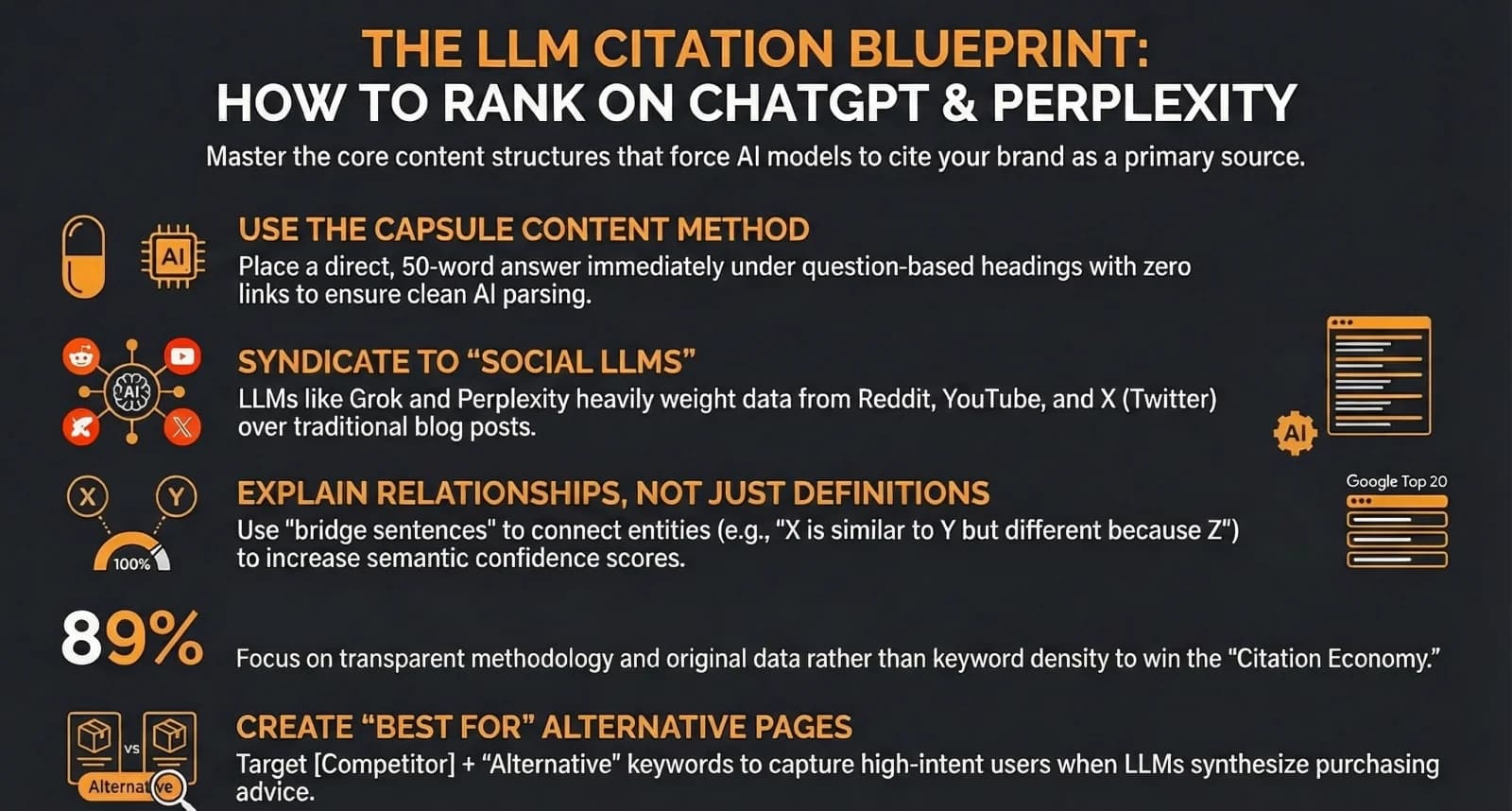
| Capsule Content Method | Structuring content with short, self-contained paragraphs that provide direct answers immediately following headers. | Write answers around 150 characters (30-50 words) with zero links in the response; provide the answer first and explain later. | Facilitates easy extraction and citation by LLMs as a standalone source; significantly increases recommendation rates. | ChatGPT, Perplexity, Google AI Overviews |
| Question-Based Headers (FAQ Style) | Structuring subheadings to mirror natural conversational language and specific user prompts. | Use H2 and H3 tags phrased as questions (e.g., What is GEO?) followed by a Bottom Line Up Front (BLUF) answer. | Matches Q&A training data structures (e.g., Quora, Reddit), leading to improved retrieval and citation rates. | ChatGPT, Claude |
| Context-Inclusive Copy | A copywriting technique ensuring every sentence or callout contains all necessary context to be understood independently. | Avoid vague pronouns (e.g., this product); use full noun phrases and the formula X is better for Y because of Z. | Allows LLMs to extract and present complete, accurate thoughts without needing to parse the entire page. | ChatGPT, Claude, Perplexity |
| Best-of Lists (Structured) | In-depth comparison pieces utilizing transparent research and testing data rather than simple lists. | Explain testing methodology upfront, include granular scoring systems (stars/numerical), and provide specific best for ratings. | LLMs prioritize content showing transparent, well-reasoned decision-making; specific phrases are often quoted directly. | Perplexity, ChatGPT, Claude |
| Semantic Depth & Relationship Mapping | Explaining the connections and relationships between different entities rather than providing simple definitions. | Add bridge sentences comparing entities and include Related questions people ask next sections. | Boosts entity match depth and confidence in the Knowledge Graph, leading to more authoritative retrieval. | Google AI Overviews, Perplexity |
| Schema Markup (Entity Specific) | Using structured data to explicitly define page subject matter for enhanced machine readability. | Leverage about, mentions, and sameAs properties to link content to authoritative IDs like Wikipedia or official records. | Critical for entity disambiguation, allowing AI systems to precisely identify and categorize page content. | Google AI Overviews, LLM Crawlers |
| Alternative Pages | Creating dedicated pages targeting competitor alternative or brand vs. brand keywords. | Discuss competitor features, pricing, and drawbacks while positioning your solution as the superior alternative. | Captures high buying intent; ensures the brand is cited even when the user initiates a query about a competitor. | Perplexity, Grok, ChatGPT |
| Micro-Tools and Frameworks | Developing browser-based tools, templates, or calculators to solve specific user problems. | Build simple assets using AI coding tools (e.g., Cursor); include supporting FAQs and detailed use-case tutorials. | Acts as a backlink magnet and encourages direct click-throughs to the site, mitigating zero-click AI summaries. | ChatGPT, Google AI Overviews |
| Social Media Syndication | Distributing website content, feature data, and brand mentions across various social platforms. | Convert blog posts into LinkedIn or Twitter (X) threads; post video content directly to Twitter for Grok optimization. | Increases brand mentions in LLMs that weight social sources heavily (e.g., Grok citing X, Perplexity citing Reddit). | Grok, Perplexity, ChatGPT |
| Non-English Market Targeting | Producing native content for less competitive international markets (e.g., Spanish, French, Portuguese). | Create original (not just translated) content in the target language to gain priority in local language citations. | LLMs give higher priority to native-language citations over English content translated on-the-fly. | Perplexity, ChatGPT, Arvo |
Original research by ManaTech
Frequently Asked Questions
How do I get my business cited by ChatGPT and other AI search engines?
Focus on 7 key strategies: create comparison content, build presence on Reddit and Quora, produce YouTube content, update existing content quarterly, use BLUF formatting with direct answers first, structure content with semantic triples, and implement FAQ schema markup. Branded web mentions now matter more than traditional backlinks for AI visibility.
Do ChatGPT, Perplexity, and Gemini use the same sources?
No. Research shows 86% of sources cited by AI platforms are unique to that platform. ChatGPT relies on Bing-based search, Perplexity pulls from broader sources weighted toward data-rich content, and Gemini leans on Google results with its own relevance scoring. You need a multi-platform content strategy.
How important is content freshness for AI search visibility?
Very important. Content cited by AI models is 25.7% fresher on average than content ranking in traditional search results. AI systems prioritize recently published or updated material because they aim to provide current answers. Updating existing content with new data and examples at least quarterly can improve citation likelihood.
What is BLUF formatting and why does it help with AI citations?
BLUF stands for Bottom Line Up Front. It means placing the direct answer to a question in the first paragraph, followed by supporting evidence and detail. AI models favor this format because it makes it easy to extract a concise, citable answer without parsing an entire article.
What are the biggest mistakes when trying to get cited by AI search?
The three biggest mistakes are treating AI optimization like traditional SEO (keyword stuffing and link schemes do not work), accidentally blocking AI crawlers like GPTBot and ClaudeBot in your robots.txt, and relying only on your own website instead of building brand presence across forums, review sites, and industry publications.
Think You've Got It?
15 questions to test your understanding — instant feedback on every answer
Question 1 of 15
According to the source material, what is the relationship between classic SEO performance on Google/Bing and performance in Generative Engine Optimisation (GEO)?
Question 2 of 15
Which social media platform's data is most heavily weighted by the LLM known as 'Grock'?
Question 3 of 15
What is the primary benefit of creating 'Alternative Pages' (e.g., 'Product A vs. Product B') for GEO?
Question 4 of 15
What percentage of ChatGPT citations are reported to come from websites that do not rank in Google's top 20 results?
Question 5 of 15
To get cited in 'Best of' listicles, what specific element should a brand include to satisfy LLMs' preference for transparent decision-making?
Question 6 of 15
In the context of 'Context-Inclusive Copy', which formula is recommended to make content more 'quotable' for AI?
Question 7 of 15
What does the acronym 'BLUF' stand for in the context of providing content for AI search?
Question 8 of 15
Microsoft's guide defines AEO (Answer Engine Optimisation) as being focused on which of the following?
Question 9 of 15
Why does providing hyper-specific context (e.g., 'non-toxic paint for beginners with kids') matter more for AI search than traditional Google search?
Question 10 of 15
Which specific Tactic involves explaining how a 401k and a Roth IRA relate to one another rather than just defining them?
Question 11 of 15
Where is the most effective place to put internal links to sibling pages for AI retrieval according to Search Engine Land?
Question 12 of 15
The 'Capsule Content Method' suggests writing short answers under headings. What is the recommended approximate length for these answers?
Question 13 of 15
When using the Capsule Content Method, what should be avoided within the initial short answer paragraph?
Question 14 of 15
If a brand has limited time, which pages does the source suggest should be prioritised for 'Capsule Method' optimisation?
Question 15 of 15
Which Schema markup property is specifically mentioned as a way to tell Google 'this page is about this specific authoritative entity'?
Related Content
Your Website Is Invisible to AI Search — Here Is How to Fix It
AI search engines like ChatGPT, Perplexity, and Gemini cannot read most business websites. If your site relies on client-side JavaScript rendering, you are invisible to the fastest-growing traffic source on the web.
Read more →blogAI Search Sends Businesses 10x More Revenue Per Click
AI-driven traffic accounts for less than 1% of visits but generates up to 11.4% of revenue. The data shows that every AI click is worth dramatically more than a traditional search click.
Read more →blogWhat Every Business Needs to Know About llms.txt
The llms.txt standard is how forward-thinking businesses communicate directly with AI search engines. Early adopters report a 30% increase in AI traffic and 25% higher click-through rates.
Read more →Want to explore this topic further?
Book a free discovery call to discuss how ManaTech can help your business implement these ideas.
Book a Discovery Call