
What Is Google Gemini 3.1 Pro and How Can Your Business Use It?
Quick Answer
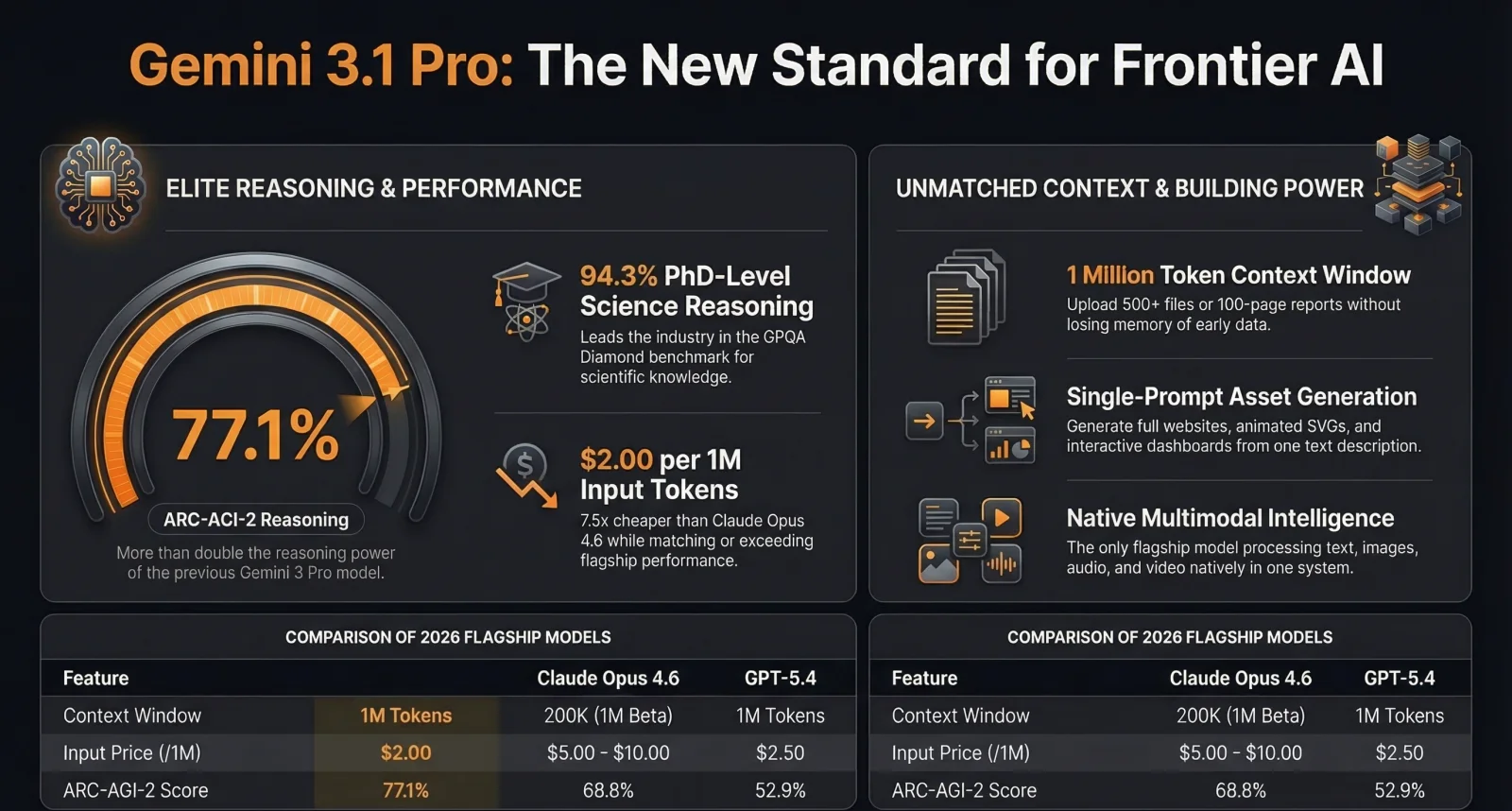
Google Gemini 3.1 Pro is the most capable model in Google's Gemini family, released on 19 February 2026. It scores 77.1% on ARC-AGI-2 — more than double Gemini 3 Pro — and leads 13 of 16 tracked benchmarks against competitors. At $2 per million input tokens, it is 7.5x cheaper than Claude Opus 4.6 while offering a 1 million token context window. For businesses building AI-powered applications, Gemini 3.1 Pro delivers flagship-level reasoning at mid-tier pricing.
Key Answers
- What is Gemini 3.1 Pro?
- Gemini 3.1 Pro is Google DeepMind's flagship AI model released 19 February 2026. It handles complex reasoning, coding, and multimodal tasks across text, images, audio, video, and code with a 1 million token context window.
- How much does Gemini 3.1 Pro cost?
- Gemini 3.1 Pro costs $2 per million input tokens and $12 per million output tokens. Prompts over 200K tokens cost $4/$18. Context cache hits cost $0.50 per million input tokens.
- How does Gemini 3.1 Pro compare to Claude and GPT?
- Gemini 3.1 Pro leads 13 of 16 benchmarks against Claude Opus 4.6. It scores 77.1% on ARC-AGI-2 versus Claude's 37.6%. Claude wins on real-world software engineering (SWE-bench Verified) and economically valuable tasks.
- What can businesses build with Gemini 3.1 Pro?
- Businesses use Gemini 3.1 Pro for document analysis, financial forecasting, legal contract review, code generation, customer support automation, and data extraction from images and videos at scale.
- What are thinking levels in Gemini 3.1 Pro?
- Thinking levels (Low, Medium, High) let developers control how much reasoning the model applies per request. Low is fast and cheap for simple tasks, High delivers deep reasoning for complex problems at higher token cost.
Key Takeaways
- Gemini 3.1 Pro scores 77.1% on ARC-AGI-2, a 148% improvement over Gemini 3 Pro's 31.1%, making it the highest-scoring model on novel reasoning tasks as of March 2026.
- At $2 per million input tokens, Gemini 3.1 Pro is 7.5x cheaper than Claude Opus 4.6 ($15) and significantly cheaper than GPT-5 while matching or exceeding their performance on most benchmarks.
- The 1 million token context window lets businesses process entire codebases, hour-long videos, or hundreds of pages of financial documents in a single prompt.
- Thinking levels (Low, Medium, High) give developers fine-grained control over cost-performance trade-offs — a feature unique to the Gemini 3 family.
- Gemini 3.1 Pro is available through Google AI Studio, Vertex AI, Gemini CLI, GitHub Copilot, and Google Antigravity, making it accessible across consumer and enterprise workflows.

What Is Google Gemini 3.1 Pro?
Gemini 3.1 Pro is Google DeepMind's flagship AI model, released on 19 February 2026. It is designed for complex tasks where simple answers are not enough — legal analysis, financial forecasting, scientific research, and large-scale code generation.
Gemini 3.1 Pro is the first 0.1 increment in the Gemini series, sitting above Gemini 3.1 Flash (fast and affordable) and Gemini 3.1 Flash-Lite (the cheapest option at $0.25 per million input tokens). The Pro tier targets enterprise workloads where reasoning quality matters more than speed.
The model processes text, images, audio, video, and code natively. Its 1 million token context window means businesses can upload entire codebases, hour-long meeting recordings, or hundreds of pages of contracts in a single prompt. Output extends to 65,536 tokens — roughly 50,000 words — making it capable of generating full reports, detailed analyses, and complete code files in one pass.
Google is shipping Gemini 3.1 Pro across its entire ecosystem: Google AI Studio for prototyping, Vertex AI for enterprise deployments, Gemini CLI for terminal workflows, GitHub Copilot for development, and Google Antigravity for building full-stack applications. This broad availability means businesses can start experimenting immediately without vendor lock-in.
How Does Gemini 3.1 Pro Compare to Claude Opus 4.6 and GPT-5?
Gemini 3.1 Pro leads 13 of 16 tracked benchmarks against Claude Opus 4.6 and GPT-5. It dominates reasoning and coding tasks while trailing on real-world software engineering and economically valuable expert tasks.
On ARC-AGI-2 — the benchmark measuring novel reasoning on problems the model has never seen — Gemini 3.1 Pro scores 77.1% compared to Claude Opus 4.6's 37.6%. That is a 2x advantage on the hardest reasoning tasks. On GPQA Diamond (graduate-level science questions), Gemini 3.1 Pro scores 94.3%. On Humanity's Last Exam without tools, it reaches 44.4%.
For coding, Gemini 3.1 Pro scores 80.6% on SWE-Bench Verified (up from 68.2% on Gemini 3 Pro) and achieves 2887 Elo on LiveCodeBench Pro — 21% above GPT-5.2. However, Claude Opus 4.6 narrowly wins on SWE-Bench Verified for real-world software engineering, and GPT-5.3 Codex leads on Terminal-Bench 2.0 with 77.3% versus Gemini's 68.5%.
The practical takeaway for businesses — which is what this guide covers — is that no single model wins everywhere. Gemini 3.1 Pro excels at reasoning-heavy tasks and multimodal processing. Claude Opus 4.6 is preferred for complex software engineering and tasks requiring careful instruction following. GPT-5.3 Codex is strongest on specialised terminal-based development. The best strategy is using the right model for each task.
What Are the Key Features That Matter for Business?
Three features set Gemini 3.1 Pro apart for business use: thinking levels for cost control, 1 million token context for processing large documents, and native multimodal input for handling images, audio, and video alongside text.
Thinking levels are a feature unique to the Gemini 3 family. Developers set a thinking_level parameter to Low, Medium, or High on each API call. Low thinking is fast and cheap — ideal for classification, extraction, and simple Q&A. High thinking activates deep multi-step reasoning for complex analysis, legal document review, and financial modelling. This means businesses can route simple tasks to Low and complex tasks to High, optimising cost without switching models.
The 1 million token context window is 5x larger than Claude Opus 4.6's 200K window. In practical terms, that is roughly 750,000 words — enough to upload an entire codebase, a year of financial statements, or a 2-hour video transcript in one prompt. For businesses processing large document sets, this eliminates the need for chunking strategies and retrieval-augmented generation (RAG) in many cases.
Native multimodal processing means Gemini 3.1 Pro can analyse images, audio files, and video natively — not through separate vision or speech models. A construction company could upload site photos and have the model generate inspection reports. A retail business could process product images for catalogue descriptions. A legal firm could analyse scanned contracts without OCR pre-processing.
How Much Does Gemini 3.1 Pro Cost?
Gemini 3.1 Pro costs $2 per million input tokens and $12 per million output tokens — the same price as Gemini 3 Pro. This makes it 7.5x cheaper than Claude Opus 4.6 on input and one of the best price-to-performance ratios of any flagship AI model.
Google maintained identical pricing to Gemini 3 Pro despite the massive performance upgrade — a strategic move to drive adoption. For prompts exceeding 200K tokens, pricing increases to $4 per million input tokens and $18 per million output tokens. Context cache hits cost just $0.50 per million input tokens, making repeated analysis of the same documents extremely cost-effective.
For consumer access, the Google AI Pro plan costs $19.99 per month (higher Gemini 3.1 Pro limits) and the Ultra plan costs $124.99 per month (highest limits plus 30TB Google One storage). Free-tier access is available through Google AI Studio with rate limits.
For businesses building AI-powered automation, the pricing advantage is significant. A workflow processing 10,000 documents per month at 5,000 tokens each would cost approximately $100 with Gemini 3.1 Pro versus $750 with Claude Opus 4.6 — a $7,800 annual saving on API costs alone.
What Can Businesses Build With Gemini 3.1 Pro?
Gemini 3.1 Pro's combination of strong reasoning, massive context, and multimodal input makes it ideal for document analysis, financial forecasting, customer support automation, code generation, and data extraction from unstructured sources.
Legal document analysis is one of the strongest use cases. A law firm can upload hundreds of pages of contracts, case files, and regulatory documents in a single prompt. Gemini 3.1 Pro can identify risks, extract key clauses, compare terms across documents, and generate summary briefs — tasks that previously required hours of paralegal time.
Financial forecasting and analysis benefits from the model's strong reasoning on quantitative tasks. Accounting firms can feed annual reports, tax documents, and market data into a single context window. The model can identify trends, flag anomalies, generate forecasts, and produce client-ready reports. With the context caching feature, re-analysing the same financial dataset with different questions costs a fraction of the initial prompt.
For businesses building custom applications — which is what ManaTech specialises in — Gemini 3.1 Pro opens new possibilities. An AI employee that handles repetitive operational tasks can now process multimodal inputs (emails with attachments, photos, voice messages) in a single inference call. Customer support systems can analyse screenshots, read error messages from images, and provide contextual help without separate OCR or vision pipelines.
Should You Switch From Your Current AI Model?
Not necessarily. The smartest approach is using the right model for each task. Gemini 3.1 Pro excels at reasoning, multimodal processing, and cost-sensitive batch workloads. Claude Opus 4.6 is better for nuanced software engineering. GPT-5.3 Codex leads on specialised coding tasks.
Modern agentic development workflows already use multiple models. An orchestrator might use Gemini 3.1 Pro for document analysis (exploiting the 1M context window), Claude Opus 4.6 for code generation (leveraging its superior instruction following), and Gemini 3.1 Flash-Lite for simple classification tasks at $0.25 per million tokens. This multi-model strategy extracts the best performance from each provider while controlling costs.
If your business currently relies exclusively on Claude or GPT and processes large volumes of documents, switching document analysis workloads to Gemini 3.1 Pro could reduce API costs by 75% or more while maintaining or improving quality. If you are building customer-facing AI features where response quality matters more than cost, Claude Opus 4.6 may still be the better choice for certain tasks.
The key consideration is vendor diversification. Relying on a single AI provider creates risk. Google, Anthropic, and OpenAI each have different strengths, pricing models, and reliability characteristics. Building applications that can route requests to the optimal model per task is the most resilient and cost-effective strategy for 2026.
What Is the Bottom Line?
Gemini 3.1 Pro is the best price-to-performance AI model available in March 2026. It leads most benchmarks, offers the largest context window of any flagship model, and costs a fraction of its competitors. For businesses building AI-powered applications, it should be part of any multi-model strategy.
Google delivered a 148% reasoning improvement over Gemini 3 Pro at zero additional cost. The 1 million token context window, thinking levels for cost control, and native multimodal processing make Gemini 3.1 Pro particularly valuable for document-heavy business workflows. It is not the best model for every task — Claude Opus 4.6 and GPT-5.3 Codex each have specialisations where they win — but it offers the widest coverage at the lowest price.
The businesses that will benefit most are those already using AI in production or planning to build custom AI-powered applications. If you are still evaluating whether AI can improve your operations, the combination of Gemini 3.1 Pro's capabilities and pricing makes 2026 the year where the cost-benefit equation tips decisively in favour of adoption.
Research Data
Key strategies and factors based on original research
| Model Name | Provider | SWE-bench Score | GPQA Diamond Score | Pricing (Input/Output per 1M Tokens) | Context Window | Max Output Tokens | Key Features |
|---|---|---|---|---|---|---|---|
| GPT-5 | OpenAI | Not in source | Not in source | $2.50 / $20.00 (cached input: $0.625) | 1M tokens | 128K tokens | Available via OpenRouter, 1M context, 128K max output, independent benchmark coverage limited. |
| Gemini 3.1 Pro | Google DeepMind | 80.6% (single attempt) | 94.3% | $2.00 / $12.00 (\le 200K context); $4.00 / $18.00 (> 200K context) | 1M tokens | 64K tokens | Native multimodal (text, image, audio, video), 3 thinking levels, 1M context in production, ARC-AGI-2 lead. |
| Claude Opus 4.6 | Anthropic | 80.8% (single) / 81.42% (prompt mod.) | 91.3% | $5.00 / $25.00 (\le 200K context); $10.00 / $37.50 (> 200K context) | 200K standard (1M beta) | 128K tokens | Extended thinking mode, Agent Teams for orchestration, 128K max output for full code files. |
Original research by ManaTech
Frequently Asked Questions
What is Google Gemini 3.1 Pro and when was it released?
Gemini 3.1 Pro is Google DeepMind's flagship AI model, released on 19 February 2026. It is the most advanced model in the Gemini 3 family, designed for complex reasoning, coding, multimodal understanding, and agentic tasks. It represents a major leap over Gemini 3 Pro with more than double the reasoning performance on key benchmarks.
How does Gemini 3.1 Pro pricing compare to Claude Opus 4.6 and GPT-5?
Gemini 3.1 Pro costs $2 per million input tokens and $12 per million output tokens. Claude Opus 4.6 costs $15/$75 per million tokens. This makes Gemini 3.1 Pro approximately 7.5x cheaper on input and 6.25x cheaper on output. GPT-5 pricing varies by tier but is generally more expensive than Gemini 3.1 Pro for equivalent tasks.
What is the context window size for Gemini 3.1 Pro?
Gemini 3.1 Pro supports a 1 million token context window (1,048,576 tokens) for input and generates up to 65,536 tokens of output. This is 5x larger than Claude Opus 4.6's 200K context window and allows processing of entire codebases, long videos, or hundreds of pages of documents in a single request.
What are Gemini 3.1 Pro thinking levels and how do they work?
Thinking levels let developers adjust how much reasoning the model applies to each request. Low thinking is fastest and cheapest for simple queries. Medium provides balanced reasoning. High applies deep multi-step reasoning for complex problems but uses more tokens and takes longer. This gives developers fine-grained control over the cost-performance trade-off per request.
Where can I access Gemini 3.1 Pro?
Gemini 3.1 Pro is available through Google AI Studio (web IDE), the Gemini API, Vertex AI (enterprise), Gemini CLI (terminal), GitHub Copilot, Google Antigravity, Android Studio, and the Gemini consumer app. The Google AI Pro plan costs $19.99 per month and the Ultra plan costs $124.99 per month for consumer access.
Is Gemini 3.1 Pro better than Claude Opus 4.6 for coding?
It depends on the task. Gemini 3.1 Pro scores higher on LiveCodeBench Pro (2887 Elo) and SWE-Bench Verified (80.6% vs 72.6%), suggesting stronger general coding ability. However, Claude Opus 4.6 is preferred by many developers for real-world software engineering workflows due to superior instruction following and code quality. GPT-5.3 Codex leads on specialised terminal-based coding tasks.
Think You've Got It?
15 questions to test your understanding — instant feedback on every answer
Question 1 of 15
What is the measured score of Gemini 3.1 Pro on the ARC-AGI-2 benchmark for abstract reasoning?
Question 2 of 15
Gemini 3.1 Pro supports a production-ready context window of how many tokens?
Question 3 of 15
What is the standard API pricing for Gemini 3.1 Pro per million input tokens for prompts under 200,000 tokens?
Question 4 of 15
How many tokens is the maximum text output for Gemini 3.1 Pro in a single response?
Question 5 of 15
Which benchmark does Gemini 3.1 Pro lead with a score of 94.3%, testing PhD-level science reasoning?
Question 6 of 15
Gemini 3.1 Pro introduces configurable 'thinking levels'. Which level is best suited for complex debugging and multi-step research?
Question 7 of 15
Unlike many competitors, Gemini 3.1 Pro is natively multimodal. Which two input types can it process directly at the API level that others often cannot?
Question 8 of 15
In the suggested agentic workflow using the 'Anti-gravity' IDE, what is the specific role assigned to Claude Opus 4.6?
Question 9 of 15
What is the primary benefit of the integration between Gemini 3.1 Pro and NotebookLM?
Question 10 of 15
By using 'Context Caching', developers can reduce their API costs for repeated prompts by up to what percentage?
Question 11 of 15
On the SWE-bench Verified benchmark for resolving real-world GitHub issues, what is the performance of Gemini 3.1 Pro?
Question 12 of 15
Which specific feature of Claude Opus 4.6 gives it an advantage over Gemini 3.1 Pro for building multi-agent systems?
Question 13 of 15
Google's 'Flash-Lite' model is designed for which of the following scenarios?
Question 14 of 15
What is the primary risk of using Gemini 3.1 Pro for complex coding tasks without a strong implementation plan?
Question 15 of 15
Gemini 3.1 Pro is described as an 'agentic' model. What does this mean in practice?
Related Content
The Rise of Agentic Development: How AI Agents Are Replacing Development Teams
The shift from writing code to orchestrating AI agents is redefining software development. What agentic development means for project timelines, costs, and the SMBs who need custom software.
Read more →blogClaude Code for Business Owners: Automate Your Business Without a Dev Team
Claude Code is an agentic coding tool that works autonomously for minutes or hours, not just completing code snippets. Nate Herk says he would teach a 10-year-old to build agentic workflows with it. Here is what business owners need to know.
Read more →blogChatGPT vs Claude vs Gemini for Small Business in 2026: A Practical Comparison
Most small business owners pick the first AI tool they try and stick with it. That is the most expensive mistake you can make in 2026. The three leading platforms — ChatGPT, Claude, and Gemini — are not interchangeable. Each one wins decisively for different tasks, and 70% of growing service firms now run all three concurrently for that exact reason.
Read more →blogWhat Is MCP (Model Context Protocol) and How Can It Transform Your Business?
Model Context Protocol (MCP) is the open standard that lets AI assistants connect to your business tools — databases, CRMs, file systems, and APIs — without custom integration code. With 18,000+ MCP servers available and backing from Anthropic, OpenAI, Google, and Microsoft, MCP is becoming the USB-C of AI.
Read more →blogClaude Skills: The Complete Guide to Building AI Workflows That Actually Work
Most people use Claude like a chatbot. Skills turn it into a reliable system that follows your exact process every time — without re-prompting, without token bloat, and without inconsistent outputs. Here is how they work and how to build your own.
Read more →Want to explore this topic further?
Book a free discovery call to discuss how ManaTech can help your business implement these ideas.
Book a Discovery Call