
AI for NZ Accountants: The Practitioner’s Guide to 2026
Quick Answer
NZ accountants in 2026 should automate four things first: bank reconciliation exception handling, GST and PAYE filing prep, client onboarding and engagement letters, and year-end work paper assembly. The Xero ecosystem makes most of this possible without leaving the tools NZ practices already use. A typical mid-size NZ practice (5–20 staff) recovers 8–15 hours per accountant per week and pays back a custom AI build in 4–6 months.
Key Answers
- What is the highest-ROI AI automation for an NZ accounting practice?
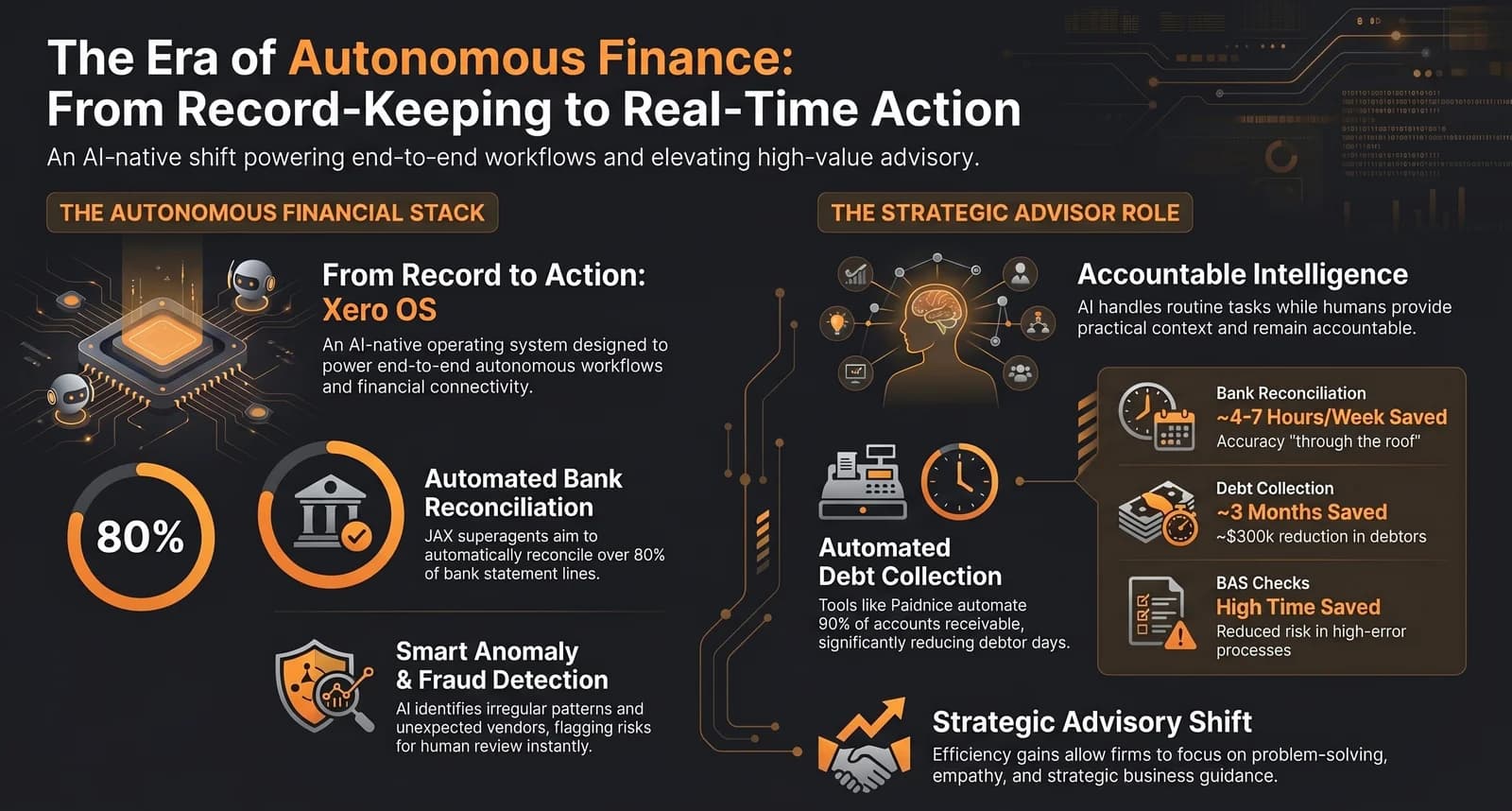
- Bank reconciliation exception handling. Xero and MYOB already auto-match the easy 70–80% of transactions — the time cost is in the remaining 20–30% of exceptions. AI classification of those exceptions saves 4–6 hours per accountant per week with a payback inside 90 days.
- How does AI work with Xero for NZ accountants?
- Xero exposes a comprehensive API that lets custom AI agents read transactions, invoices, and journal entries. NZ practices commonly build AI layers that classify uncategorised transactions, draft client emails from Xero data, and generate advisory commentary on Xero reports — all without leaving the Xero workflow.
- Will AI replace NZ accountants?
- No. AI replaces accounting tasks, not accountants. Compliance still requires a human signature, advisory still requires a human relationship, and IRD still expects an authorised person on file. AI removes the lowest-leverage hours so NZ accountants can spend more time on advisory work, where margins are higher.
- How much does it cost to build a custom AI tool for an NZ accounting firm?
- A focused custom AI build (one workflow — e.g. bank rec exception handling) typically runs $8,000–$15,000 NZD plus a $1,000–$1,500/month support retainer. A multi-workflow AI Operating System for the practice runs $25,000–$60,000 NZD. Most NZ practices see payback within 4–6 months on the focused build.
- Is client data safe when using AI in an NZ accounting practice?
- Yes, when built correctly. Custom AI integrations can run inside the practice’s own Microsoft 365 or Google Workspace tenant, with no client data leaving NZ. Generic SaaS AI tools that pipe client data through US-based models without data-residency guarantees should be avoided for any practice handling sensitive client tax information.
Key Takeaways
- NZ accountants spend 30–40% of their week on tasks that AI can now do reliably — bank rec exceptions, GST prep, document chasing, and engagement letter drafting.
- The Xero ecosystem (Xero, Xero Practice Manager, Hubdoc) is the fastest path to AI value for NZ practices because the API is mature and most data already lives there.
- AI replaces the lowest-margin hours in a practice (compliance prep) and frees up capacity for the highest-margin work (advisory). Most NZ firms see 15–20% utilisation lift inside 6 months.
- A focused custom AI build for one workflow typically costs $8,000–$15,000 NZD with payback inside 90 days; a full practice AI Operating System runs $25,000–$60,000 NZD with payback in 4–6 months.
- NZ-specific data residency and IRD compliance are non-negotiable — build custom inside your existing Microsoft 365 or Google Workspace tenant rather than piping data to generic US AI SaaS.
Why NZ Accountants Are Behind on AI (and Why That Is About to Change)
The 2025 Xero State of the Industry report put it bluntly: 73% of NZ accounting practices say AI is "important to their future" but only 18% have actually deployed an AI workflow that staff use daily. The gap is not interest. It is implementation. Most NZ practices have looked at generic ChatGPT subscriptions, decided that is not enough, and stalled on the question of what to actually build.
That stall is about to break. Three things changed in the last 12 months. First, the Xero developer platform now exposes enough API surface to build practice-specific AI agents without an army of developers. Second, large language models cleared the reliability threshold for the prep work NZ accountants do all day — transaction classification, document extraction, advisory drafting. Third, NZ-specific tooling (Karbon, FYI Docs, Suitefiles) added native AI hooks that integrate with the Xero ecosystem. The result is that an NZ practice in 2026 can ship a meaningful AI workflow in 4–8 weeks for under $15,000 NZD. That was not true in 2024.
The 5 Highest-ROI AI Automations for an NZ Accounting Practice
Xero already auto-matches around 70% of transactions out of the box. The time cost in any practice is the remaining 30% — transactions where the bank statement memo does not cleanly map to a contact or account code. AI classification on the unmatched tail typically picks the right account 85–95% of the time on first pass, leaving a small reviewer queue rather than the full backlog. NZ practices we have built this for save 4–6 hours per accountant per week, every week.
GST and PAYE prep is mechanical work that consumes senior staff time because it is mechanical work that requires senior judgement on the edge cases. AI handles the bulk pass — GST status on borderline transactions, PAYE reconciliation against payroll exports, missing supplier invoice chasers — and produces a draft return with a written explanation memo for the senior to sign off. The actual filing still goes through Xero or MYOB to IRD via the authorised gateway, with a human authorisation. AI compresses the prep, not the compliance.
New client onboarding is one of the most repeatable workflows in any NZ practice and one of the most variable in execution quality. AI agents can run the intake form, fetch the company data from the Companies Office register, draft the engagement letter from the firm’s template, request authority from IRD, and create the client in Xero Practice Manager — inside 24 hours, with the partner reviewing rather than drafting. NZ practices report cutting onboarding time from 2–3 weeks to 2–3 days.
The 31 March financial year end is the highest-pressure window in any NZ practice. Most of the time spent in the first two weeks of April is mechanical — pulling the trial balance, drafting year-end journals, classifying accounts against the firm’s tax templates, and assembling the work paper file. AI agents can do the bulk pass overnight, on every client, before the senior accountant reaches their desk. The reviewer still signs every set of accounts — but they sign the work, not the prep.
Advisory is where NZ accounting practice margins live in 2026. The constraint is not insight — senior accountants have plenty of insight — it is the time cost of producing the written advisory note that turns insight into a billable deliverable. AI can read a client’s Xero data, identify the three to five things worth raising this quarter, and draft an advisory note in the firm’s voice. The senior accountant edits and personalises rather than starts from blank. Firms running this report a 30–40% lift in advisory revenue per partner.
NZ-Specific Tools and Integrations Worth Planning Around
NZ practices have a sharper toolset than US firms because Xero is the dominant ledger and most adjacent tools are built around it. The high-value integration surface for an AI build is Xero (transaction data and reporting), Xero Practice Manager (job and client data), Hubdoc (document capture), MYOB Practice (some firms still use this), Karbon and FYI Docs (workflow and document management), and the IRD myIR gateway (filing). Almost every meaningful AI workflow inside an NZ practice talks to two or three of those systems.
Data residency is the constraint US-built AI tools usually fail. NZ accountants handle client tax information that should not be piped through generic US AI SaaS without data-residency guarantees. The right pattern in 2026 is to run the AI inside the practice’s own Microsoft 365 or Google Workspace tenant — both have AI offerings (Copilot and Gemini) with appropriate data-handling commitments, and both can be integrated against Xero via custom code that lives inside the firm’s own infrastructure.
What Does It Actually Cost an NZ Practice?
A focused custom AI build for one of the five workflows above typically runs $8,000–$15,000 NZD plus a $1,000–$1,500 monthly support retainer. A practice-wide AI Operating System covering multiple workflows runs $25,000–$60,000 NZD plus $2,000–$3,000 monthly. SaaS AI add-ons (Karbon, Xero AI features, generic ChatGPT subscriptions) sit underneath those numbers but typically deliver less workflow-specific value because they are built for a generic firm.
The payback maths are straightforward. A 10-staff NZ practice billing $1.5M per year carries roughly 15,000 chargeable hours. If AI recovers even 10% of those hours — 1,500 hours — at an average rate of $150/hr, that is $225,000 in recovered capacity. A $15,000 focused build pays back inside the first month it is in production. Even allowing for change management, training time, and the senior staff hours spent reviewing AI output, the payback is consistently inside 4–6 months across the NZ practices we have built for.
How to Get Started
Pick one workflow. The biggest mistake NZ practices make is trying to deploy AI across the whole practice in one go — the change management overhead kills momentum. Pick the workflow with the highest hourly bleed (usually bank rec exceptions or year-end work papers) and ship that first. Get it into staff hands inside 8 weeks. Measure the time recovered. Then pick the next one.
Match the build to the practice. Generic AI SaaS makes sense for firms under 5 staff. Custom builds typically pay back faster for firms above 10 staff because the workflow fit is materially better and the time recovered is multiplied across more accountants. The break-even is usually around 8–10 staff.
Plan for the human in the loop. Every workflow above keeps a senior accountant in the loop — either as the reviewer who signs off the AI output or as the relationship owner who delivers the advisory note. AI is the prep layer, not the practitioner. The practices that succeed treat AI as a junior staff member who is fast, cheap, and tireless but always reports to a partner. The practices that fail treat AI as a replacement and find out the hard way that compliance, IRD, and clients still want a human signature.
If you are running an NZ accounting practice and want to scope a focused AI build for one workflow, book a 30-minute discovery call. We will walk you through what makes sense for your firm size, what the realistic 90-day outcome looks like, and — if there is no fit — tell you which SaaS tool to buy instead.
Research Data
Key strategies and factors based on original research
| use case name | time saved per week | payback period in months | integration platform (Xero/MYOB/etc) | implementation complexity (low/medium/high) |
|---|---|---|---|---|
| Automatic bank reconciliation (JAX) | 4-7 hours | Not in source | Xero | low |
| Debt collection automation (Paidnice) | 80-90% of role automated | 3 months | Xero / QuickBooks | low |
| AI-powered BAS checking | Not in source | Not in source | MYOB | medium |
| Predictive cash flow forecasting | Not in source | Not in source | Xero / MYOB | medium |
| AI-powered Advisory Commentary (Fathom) | Not in source | Not in source | Fathom | medium |
| AI-assisted Bookkeeping (Dext AI Assist) | Not in source | Not in source | Dext | medium |
Original research by ManaTech
Frequently Asked Questions
Which AI tools are NZ accountants actually using in 2026?
Three patterns are common. First, generic ChatGPT/Claude/Gemini for client emails and advisory drafting (used by almost every practice). Second, AI add-ons inside Xero and Karbon for transaction classification (used by mid-size firms). Third, custom-built AI integrations against the Xero and MYOB APIs for practice-specific automations (used by firms above 10 staff who have outgrown the SaaS add-on tier).
How does AI handle the 31 March NZ financial year end?
Year-end work paper assembly is one of the strongest AI use cases for NZ practices. AI agents can pull trial balance data from Xero, classify accounts against the firm’s tax templates, draft year-end journals, and generate the audit trail — all in the days immediately after 31 March, when staff capacity is the binding constraint. Most firms still have a senior reviewer sign off, but the prep work compresses from days to hours.
Can AI handle GST and PAYE filings to IRD?
AI does not file directly to IRD — that requires authorised gateway services and typically goes through Xero or MYOB. But AI does the prep: classifying GST status on borderline transactions, flagging late or missing supplier invoices, reconciling PAYE deductions against payroll, and drafting the explanation memo for the senior accountant who signs off. The filing itself stays with the human and the gateway.
What is the difference between a custom AI build and a SaaS AI add-on?
SaaS add-ons are fast to deploy but generic — every firm gets the same workflow whether it fits or not. Custom builds map to your specific practice: your client segmentation, your work paper templates, your advisory product. SaaS makes sense for firms under 5 staff. Custom typically pays back faster for firms above 10 staff because the workflow fit is materially better.
How long does it take to roll out AI inside an NZ accounting practice?
A single-workflow custom build is 4–8 weeks from kickoff to staff using it daily. A full practice-wide AI rollout (multiple workflows, training, and change management) is 3–6 months. Most NZ practices we work with start with one focused workflow, prove the ROI in 90 days, then expand.
Is it worth doing this now or waiting until the AI landscape settles?
Now. The technology has stabilised enough for production use — the Xero, MYOB, and IRD integration patterns are mature, and the leading models (Claude, GPT, Gemini) deliver reliably for the workflows NZ practices need. Practices waiting for "the technology to settle" are watching their per-accountant productivity gap widen against firms that have already shipped. The cost of waiting another 12 months at average NZ accountant rates is approximately $40,000 in unrecovered productive time per accountant.
Think You've Got It?
10 questions to test your understanding — instant feedback on every answer
Question 1 of 10
According to Xero's guide, which branch of artificial intelligence is primarily responsible for automating data-entry and coding tasks by identifying patterns?
Question 2 of 10
What is the primary target for Xero's 'JAX' (Just Ask Xero) financial superagent as described in the 2026 updates?
Question 3 of 10
MYOB Solo is specifically designed to meet the needs of which type of worker?
Question 4 of 10
What goal does Xero have for its automatic bank reconciliation feature regarding statement lines?
Question 5 of 10
Which software was highlighted by Tyler Caskey for its ability to automate 80%--90% of the accounts receivable role?
Question 6 of 10
Why does Xero describe its AI as being grounded in 'decisioned data'?
Question 7 of 10
In the context of adopting new accounting technology, what does the 'hockey-stick' shape represent?
Question 8 of 10
What significant change did Xero implement regarding its API for app developers in early 2026?
Question 9 of 10
Which feature of the 'Xero Ultra' beta is designed specifically for larger businesses or retail operations?
Question 10 of 10
How does Fathom's new AI feature assist in the management reporting process?
Related Content
Building an AI Employee: Custom Applications That Replace Repetitive Tasks
How custom-built AI systems act as digital employees, handling meeting notes, inbox management, analytics, and onboarding so your team can focus on growth.
Read more →blogWhen Should You Outgrow Zapier and Build a Custom Automation System?
Zapier is the right tool until it is not. When your automation bill exceeds $500-1,000 per month, workflows break at critical moments, or you need logic that a visual builder cannot express, it is time to consider a custom automation system. One company went from $600 per month on Zapier to $75 per month with a custom build.
Read more →blogHow to Build AI Agents for Your Business Without Writing Code
AI agents go beyond chatbots — they take actions, make decisions, and complete multi-step workflows autonomously. IDC expects AI copilots embedded in 80% of enterprise apps by 2026. Here is how to build your first AI agent without code.
Read more →blogAI Voice Agents for Business: The Complete 2026 Guide
AI voice agents handle inbound calls, qualify leads, and book appointments 24/7 — without hiring staff. This guide covers what they are, what they cost, and how to deploy one for your business.
Read more →blogHow to Measure the ROI of AI Automation in Your Business
AI automation delivers measurable returns in 90-180 days when scoped correctly — but 95% of AI projects fail because businesses skip baseline measurement. Here is a practical framework for measuring AI ROI across efficiency, revenue, and cost reduction.
Read more →Want to explore this topic further?
Book a free discovery call to discuss how ManaTech can help your business implement these ideas.
Book a Discovery Call