
AI Automation for Real Estate Agents: What to Automate First in 2026
Quick Answer
Real estate agents should automate lead follow-up first — it delivers the highest ROI because speed-to-lead is the single biggest predictor of conversion. Agents who respond within 5 minutes are 100x more likely to connect than those who wait 30 minutes. After lead response, automate listing descriptions, market analysis reports, and appointment scheduling. McKinsey estimates agentic AI could automate 50-60% of real estate workflows by 2027, and agents using AI tools already report 2-3x more closings per year.
Key Answers
- What should real estate agents automate first with AI?
- Start with lead follow-up and qualification. AI can respond to new enquiries within seconds via text, email, or voice — 24/7. Speed-to-lead is the highest-ROI automation because a 5-minute response is 100x more effective than a 30-minute one.
- How much time can AI save real estate agents?
- AI automation saves real estate agents 15-25 hours per week by handling lead follow-up, listing descriptions, market reports, scheduling, and social media content. That time goes directly back into client-facing activities that close deals.
- What are the best AI tools for real estate agents in 2026?
- Top AI tools for real estate include ChatGPT and Claude for listing descriptions, Ylopo and kvCORE for lead nurture, AI voice agents like Retell for call handling, and Canva AI for marketing materials. The best stack depends on your deal volume and budget.
- How much does AI automation cost for real estate?
- Basic AI automation starts free (ChatGPT for copywriting). A comprehensive stack — CRM with AI lead scoring, automated follow-up, AI voice agent, and marketing automation — costs $300-$1,500 per month. Most agents recoup the cost with one additional closing per quarter.
- Will AI replace real estate agents?
- AI will not replace real estate agents — it will replace agents who refuse to use AI. The relationship, negotiation, and local expertise that agents provide cannot be automated. AI eliminates the administrative burden so agents can focus on what humans do best.
Key Takeaways
- Agents who respond to leads within 5 minutes are 100x more likely to connect — AI automates instant response across text, email, and phone 24/7.
- McKinsey estimates agentic AI could automate 50-60% of real estate operational tasks by 2027, with leasing and property management seeing the highest impact.
- AI-generated listing descriptions perform 30-40% better in engagement than generic templates — tools like ChatGPT and Claude write compelling descriptions in seconds.
- Real estate agents using AI tools report closing 2-3x more deals per year by reclaiming 15-25 hours per week from administrative tasks.
- The highest-ROI automation stack for most agents costs $300-$800 per month and pays for itself with one additional closing per quarter.
Why Do Real Estate Agents Need AI Automation in 2026?
Real estate agents spend up to 70% of their working hours on administrative tasks — lead follow-up, scheduling, listing descriptions, market analysis, and paperwork — leaving only 30% for the client-facing work that actually closes deals.
The economics are clear. According to McKinsey, agentic AI could automate 50-60% of real estate operational tasks by 2027. The firm's analysis shows that leasing, property management, and tenant communications are the highest-impact areas, but individual agents stand to gain just as much by automating the repetitive workflows that eat their days.
The competitive pressure is accelerating. NAR data shows 82% of homebuyers found their property online in 2025. Buyers expect instant responses, professional marketing materials, and data-driven market insights. Agents who deliver these manually are competing against agents whose AI handles it in seconds.
The same revenue-generating AI automations that work across industries — lead nurture, content creation, client communication, data analysis, and workflow automation — have outsized impact in real estate because agent income is directly tied to deal volume. More automation means more deals.
How Does AI Lead Follow-Up Work for Real Estate?
AI lead follow-up systems respond to new enquiries within seconds — via text, email, or phone call — qualifying the lead, answering property questions, and booking viewings automatically while the agent focuses on closings.
Speed-to-lead is the single most important metric in real estate sales. Research from InsideSales shows that contacting a lead within 5 minutes makes you 100x more likely to connect compared to waiting 30 minutes. Yet the average real estate agent takes 47 hours to follow up on a new online lead. AI eliminates this gap entirely.
Here is how a modern AI lead follow-up system works. A buyer enquires through your website at 9 PM on a Saturday. Within 30 seconds, AI sends a personalised text message acknowledging their interest in the specific property, asks two qualifying questions (budget range and timeline), and offers to book a viewing. If the lead responds, the AI continues the conversation, checks your calendar availability, and confirms the appointment — all before you wake up Sunday morning.
Platforms like Ylopo, kvCORE, and Follow Up Boss now include AI-powered lead nurture that handles multi-step follow-up sequences. The AI adapts its messaging based on lead behaviour — sending different messages to a lead who viewed 12 listings versus one who viewed 2, adjusting follow-up frequency based on engagement, and escalating hot leads to the agent immediately.
For phone-based leads, AI voice agents answer calls within 1 second, qualify the buyer (budget, timeline, suburb preferences), and book a viewing directly into the agent's calendar. After-hours calls that would have gone to voicemail — where 80% of callers never call back — are now converted into booked appointments.
How Can AI Write Better Listing Descriptions and Marketing Copy?
AI generates compelling, accurate listing descriptions in 15-30 seconds — outperforming generic templates by 30-40% in engagement metrics — by combining property data with persuasive language patterns optimised for buyer psychology.
Writing listing descriptions is one of the most time-consuming tasks in real estate marketing. A typical agent lists 15-30 properties per year and spends 30-60 minutes crafting each description. That is 15-30 hours per year on descriptions alone. AI tools like ChatGPT and Claude produce high-quality first drafts in seconds.
The workflow is straightforward. Input the property details — 3 bedrooms, 2 bathrooms, 180 square metres, renovated kitchen, north-facing deck, 600-metre walk to the train station — and tell the AI your target buyer profile and tone. Within seconds you have a polished description that highlights the strongest selling points, uses emotional triggers that resonate with buyers, and follows proven copywriting structures.
AI also generates social media content, email campaigns, market update newsletters, and open home announcements. Agents report creating an entire marketing package for a new listing — description, Facebook ad copy, Instagram caption, email blast, and flyer text — in under 10 minutes compared to 2-3 hours manually.
Tools like Canva AI, Styldod, and Epique generate property marketing visuals — virtual staging, floor plan rendering, and branded social media graphics — that previously required a graphic designer. Virtual staging alone saves $300-$500 per listing compared to traditional staging and produces results in minutes instead of days.
How Does AI Automate Market Analysis and Comparative Reports?
AI-powered market analysis tools pull real-time sales data, analyse comparable properties, and generate branded CMA reports in minutes — replacing the 2-4 hours agents typically spend compiling this information manually.
Comparative Market Analysis reports are the foundation of pricing conversations with sellers. Traditional CMAs require pulling recent sales data, selecting appropriate comparables, adjusting for differences, and formatting the report — a process that takes 2-4 hours per property. AI tools like HouseCanary, Remine, and cloud-based CMA platforms automate the entire workflow.
The AI analyses thousands of data points — recent sales within a radius, days on market, price reductions, seasonal trends, neighbourhood demographics, school zones, and zoning changes — to produce a price recommendation with confidence intervals. Instead of presenting three cherry-picked comparables, you present a data-driven analysis that builds seller confidence.
For agents tracking their own business performance, AI also automates the ROI measurement of AI tools — tracking which automations generate the most leads, which lead sources convert best, and where to invest next. Data-driven agents consistently outperform intuition-driven agents.
How Can AI Handle Client Communication and Scheduling?
AI automates the communication that keeps deals moving — appointment scheduling, viewing reminders, status updates, document requests, and post-sale follow-ups — without the agent typing a single message.
A typical real estate transaction involves 50-100 individual communications between agent, buyer, seller, lawyer, inspector, and lender. AI automation handles the routine ones — viewing confirmations, document reminders, timeline updates, and milestone notifications — while flagging the ones that need the agent's personal attention.
AI scheduling tools integrate with Google Calendar, Outlook, and real estate CRMs to eliminate the back-and-forth of booking viewings. A buyer clicks a property listing, selects an available time slot, and the AI confirms with both parties, sends directions, adds the viewing to the agent's route for the day, and follows up afterward to collect feedback.
Think of this as building an AI employee for your real estate business — a digital assistant that handles the administrative workload of a full-time office coordinator at a fraction of the cost. The AI never forgets a follow-up, never misses a deadline reminder, and never lets a lead go cold because it was a busy week.
What Does the Ideal AI Automation Stack Look Like for Real Estate?
The ideal real estate AI stack combines an AI-powered CRM for lead management, AI voice agents for call handling, LLM tools for content creation, and workflow automation for everything in between — costing $300-$1,500 per month depending on deal volume.
Layer 1: AI-Powered CRM ($50-$300/month). Platforms like kvCORE, Follow Up Boss, LionDesk, or Lofty (formerly Chime) provide the central hub — contact management, AI lead scoring, automated drip campaigns, and pipeline tracking. The CRM is the brain that connects all other automations.
Layer 2: AI Voice and Chat ($50-$200/month). An AI voice agent handles inbound calls and a chatbot handles website visitors. These are your 24/7 front desk — qualifying leads, answering FAQs, and booking appointments while you sleep. Retell AI, Bland AI, and My AI Front Desk are purpose-built for this.
Layer 3: Content and Marketing AI ($20-$100/month). ChatGPT Plus or Claude Pro for listing descriptions, email campaigns, and social content. Canva AI for marketing visuals. AI virtual staging tools like Styldod for listing photos. This layer replaces $1,000-$2,000 per month in freelancer costs.
Layer 4: Workflow Automation ($50-$200/month). Tools like Make.com, n8n, or Zapier connect your CRM, email, calendar, and AI tools into automated workflows. When your automation needs grow complex, you may find yourself outgrowing simple automation platforms — at that point, a custom-built system that integrates everything natively becomes more cost-effective and reliable.
What Is the Best Order to Implement AI Automation?
Implement in order of ROI: lead follow-up first (week 1), listing descriptions and marketing (week 2), scheduling and client communication (week 3), and market analysis reports (week 4). Each layer builds on the previous one.
Week 1: Set up AI lead response. Connect your website enquiry forms, portal leads (realestate.co.nz, Trade Me Property), and phone line to an AI responder. Configure qualifying questions, appointment booking, and handoff rules. Test with 10-20 leads before going fully live.
Week 2: Build your AI content templates. Create prompts for listing descriptions, social media posts, email campaigns, and market updates in ChatGPT or Claude. Save them as reusable templates. A good set of 5-10 templates covers 90% of your marketing needs.
Week 3: Automate scheduling and communications. Connect your calendar to an online booking tool with AI confirmation. Set up automated viewing reminders, feedback requests, and milestone updates for active transactions.
Week 4: Deploy AI market analysis. Set up automated CMA generation for listing appointments. Configure weekly market digest reports for your database. Build automated price alert notifications for buyers in your CRM.
What Does McKinsey Predict for AI in Real Estate?
McKinsey projects that agentic AI could automate 50-60% of real estate operational workflows by 2027, with the biggest gains in leasing, property management, and tenant communications.
McKinsey's 2025 analysis of agentic AI in real estate identifies five categories of workflow automation: tenant and owner communications, financial reporting, maintenance management, leasing operations, and market analysis. The firm estimates that 50% of current manual tasks in property management and 40% in brokerage can be fully or partially automated with current AI technology.
The McKinsey research highlights a critical finding: AI adoption in real estate is not about replacing human judgment. It is about eliminating the operational overhead that prevents agents from exercising that judgment more often and with more clients. The firms and agents that adopt AI first will set new service standards that late adopters cannot match without the same tools.
The report also notes that AI integration works best when it augments existing workflows rather than replacing them entirely. Agents who try to automate everything — including relationship-building and negotiation — underperform agents who automate administrative tasks and redirect that time into client-facing activities.
What Is the Bottom Line?
AI automation is the biggest competitive advantage available to real estate agents in 2026. Start with lead follow-up — it has the highest ROI — then layer in content creation, scheduling, and market analysis. A $300-$800 monthly AI stack pays for itself with one extra closing per quarter.
The agents who will thrive in 2026 and beyond are not the ones who resist AI — they are the ones who use it to reclaim their time and reinvest it in relationships, negotiation, and local expertise. Those are the skills AI cannot replicate. Everything else is automation waiting to happen.
If you are a real estate agent or agency looking to build a custom AI automation system tailored to your specific workflows, market, and client base — rather than piecing together generic tools — ManaTech builds exactly that. We design and deploy AI systems that integrate with your existing CRM, phone system, and marketing stack to create a seamless automation layer that works the way you work.
Research Data
Key strategies and factors based on original research
| use case name | category (lead gen/marketing/admin/client service) | time saved per week | tools/platforms | implementation difficulty | estimated cost | ROI potential |
|---|---|---|---|---|---|---|
| Multilingual Inbound Receptionist | client service/lead gen | 10-20 hours | Vappy, 11 Labs, Quo | Medium | Approx. $1,800/month savings compared to VAs | High (Detects and switches languages mid-call for global buyers) |
| AI-Powered Contract Review and Analysis | admin | 10-15 hours | Luminance, Juro.com | High | Not in source | Medium (High efficiency for legal teams but significant setup) |
| AI Video Outreach (Avatars) | marketing/lead gen | 5-10 hours | HeyGen, Synthesia, Mike Seitz Playbook | High | Not in source | High (Sends hyper-personalized video messages to hundreds of leads) |
| Photo-to-Video Transformation | marketing | 3-5 hours | PhotoAIVideo.com, Amplifiles | Low | $37.5/month (PhotoAIVideo) or $1.50/image (Amplifiles) | High (Creates cinematic property videos at a fraction of videography costs) |
| AI Note-Taking and CRM Integration | admin | 3-5 hours | Fireflies AI, Quo, Plaud.io | Low | Not in source | Medium (Ensures 100% data capture during client calls/meetings) |
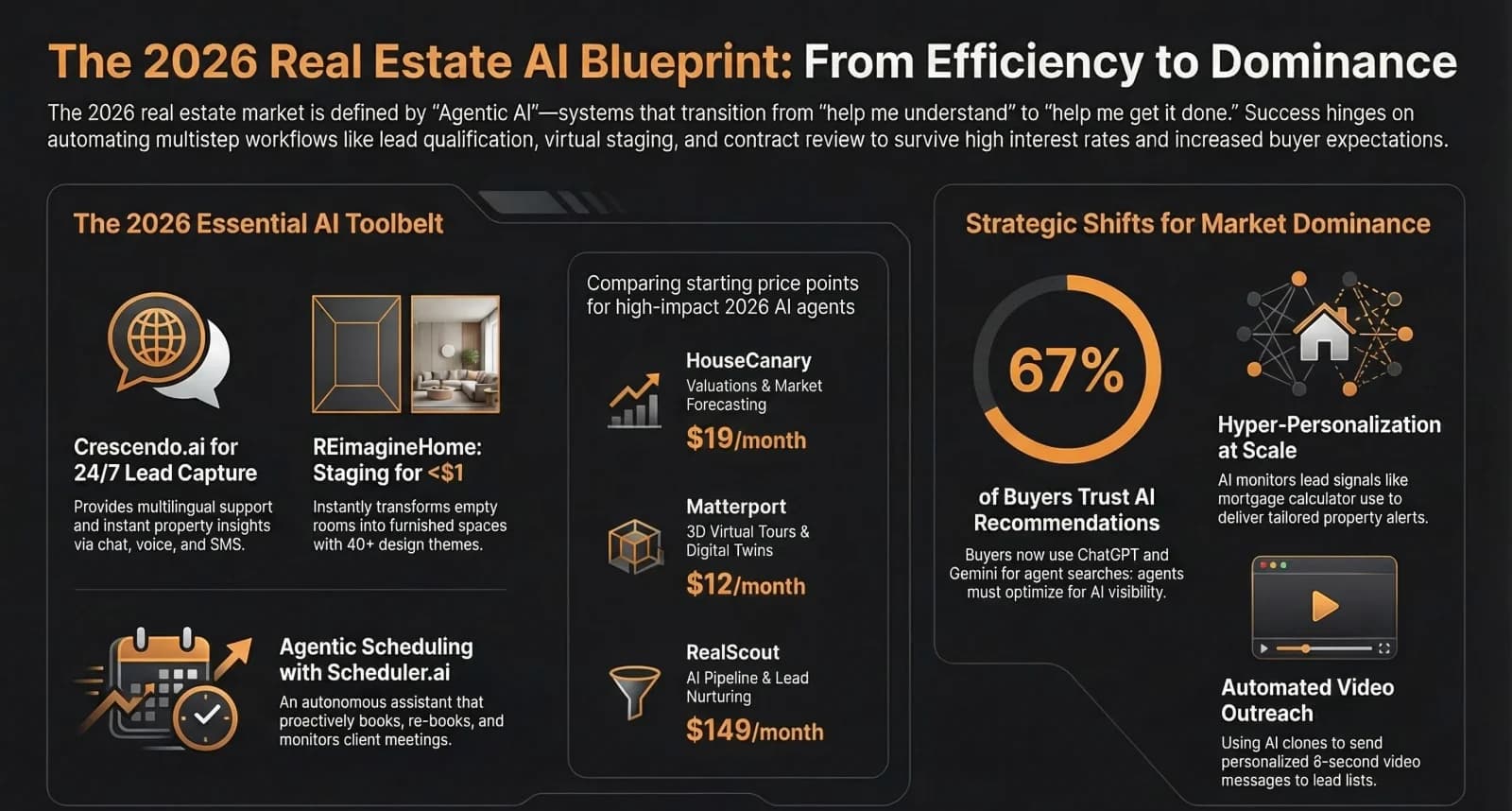
| 3D Virtual Tours and Digital Twins | marketing | 1-2 hours | Matterport, HomeStack Apps | Medium | $12/month | High (Reduces dependency on physical showings and increases conversion) |
| Market Insights and Property Valuation | admin/client service | 1-2 hours | HouseCanary, Remine, Revaluate | Low | $19/month (HouseCanary) | High (Provides 2.5% accuracy in AVMs and forecasting) |
| AI Lead Nurturing and Pipeline Engagement | lead gen/marketing | Not in source | RealScout, Ylopo, Follow Up Boss | Medium | $149/month (RealScout) | High (Increases transaction volume by up to 54%) |
| AI Rental and Property Management | admin/client service | Not in source | MagicDoor | Medium | Freemium (Basic is free; fees for specific transactions) | High (Boosts productivity up to 5x and reduces ops costs by 60%) |
| Automated Scheduling and Appointment Setting | admin | Not in source | scheduler.ai | Medium | $50/month | High (Eliminates manual back-and-forth for showings and meetings) |
| 24/7 Lead Capture and Customer Support | lead gen/client service | Not in source | Crescendo.ai, Tidio, SmartAgent | Low | Starts from $1.25/resolution | High (Provides 24/7 multilingual support and instant lead qualification) |
| AI Virtual Staging | marketing | Not in source | REimagineHome, Virtual Staging AI, Nano Banana | Low | $14/month (REimagineHome) or Free (Nano Banana) | High (Furnishes empty spaces digitally for under $1 per image) |
Original research by ManaTech
Frequently Asked Questions
Is AI-generated real estate content compliant with advertising regulations?
AI-generated listing descriptions, market reports, and marketing copy must still comply with Fair Housing Act requirements and local real estate advertising rules. Always review AI output for accuracy, prohibited language, and compliance before publishing. AI is a drafting tool — the agent is still legally responsible for all published content.
Can AI write accurate property listing descriptions?
AI writes strong first drafts of listing descriptions in 15-30 seconds. Feed it the property details — bedrooms, bathrooms, square footage, standout features, neighbourhood highlights — and it produces engaging copy. Agents should always fact-check details and add local knowledge that AI cannot access, like "three minutes from the new Pak'nSave" or "north-facing living with Rangitoto views."
How do AI voice agents work for real estate lead qualification?
AI voice agents answer inbound calls within 1 second, ask qualifying questions (budget, timeline, property type, suburb preferences), book appointments directly into your calendar, and send a summary to your CRM. They handle after-hours calls that would otherwise go to voicemail — where 80% of callers never call back.
What data do I need before implementing AI automation?
At minimum, you need a CRM with clean contact records (name, phone, email, enquiry source). For AI lead scoring, you also need historical conversion data — which leads became clients and how they engaged. Most agents can start with basic automations immediately and build data quality over time.
Can small or solo real estate agents afford AI automation?
Solo agents can start with free or low-cost AI tools — ChatGPT for listing descriptions ($20/month), automated email sequences in their existing CRM, and a simple AI chatbot on their website. A full AI stack costing $500-$800 per month pays for itself if it generates even one additional sale per quarter.
How long does it take to set up AI automation for real estate?
Basic automations (AI copywriting, email sequences, chatbot) can be set up in a single afternoon. A comprehensive stack with AI voice agents, CRM integration, lead scoring, and automated marketing takes 2-4 weeks to configure and test properly.
Think You've Got It?
15 questions to test your understanding — instant feedback on every answer
Question 1 of 15
According to McKinsey, how does 'agentic AI' differ from previous applications of generative AI in real estate?
Question 2 of 15
What is the 'Zillow moment of 2026' described in the context of AI search trends?
Question 3 of 15
Which AI tool is specifically recommended for turning static listing photos into cinematic walkthrough videos with 'truck left' and 'drone up' movements?
Question 4 of 15
In the 'Five Technical Layers' of agentic AI, what is the primary role of the 'Control Layer'?
Question 5 of 15
According to the source material, what percentage of buyers are comfortable choosing an agent based on what AI recommends?
Question 6 of 15
Which tool would a realtor use to understand the exact questions local buyers are asking on Google and Chat GPT to inform their content strategy?
Question 7 of 15
What is the primary benefit of the 'Shadow Research Phase' becoming longer and more sophisticated?
Question 8 of 15
McKinsey suggests that organizations should 'automate steps and protect thoughts'. What constitutes a 'thought' in this operational model?
Question 9 of 15
Which AI tool allows realtors to virtually stage empty rooms for free by uploading photos and describing the furniture they want to add?
Question 10 of 15
How does Crescendo.ai's 'VoC Insights' platform help real estate teams improve their business strategy?
Question 11 of 15
Which platform is recommended for creating lead magnets like 'Relocation Guides' or 'Buyer Guides' in under 60 seconds using AI?
Question 12 of 15
What unique capability of 'Plaud.io' makes it useful for real estate listing presentations?
Question 13 of 15
In the context of AI search optimisation, what is the role of YouTube transcripts?
Question 14 of 15
How does 'Manis' assist a real estate agent's content strategy differently than Chat GPT?
Question 15 of 15
What is the primary function of the tool 'RealScout' in a realtor's AI toolkit?
Related Content
Building an AI Employee: Custom Applications That Replace Repetitive Tasks
How custom-built AI systems act as digital employees, handling meeting notes, inbox management, analytics, and onboarding so your team can focus on growth.
Read more →blogWhen Should You Outgrow Zapier and Build a Custom Automation System?
Zapier is the right tool until it is not. When your automation bill exceeds $500-1,000 per month, workflows break at critical moments, or you need logic that a visual builder cannot express, it is time to consider a custom automation system. One company went from $600 per month on Zapier to $75 per month with a custom build.
Read more →blogHow to Build AI Agents for Your Business Without Writing Code
AI agents go beyond chatbots — they take actions, make decisions, and complete multi-step workflows autonomously. IDC expects AI copilots embedded in 80% of enterprise apps by 2026. Here is how to build your first AI agent without code.
Read more →blogAI Voice Agents for Business: The Complete 2026 Guide
AI voice agents handle inbound calls, qualify leads, and book appointments 24/7 — without hiring staff. This guide covers what they are, what they cost, and how to deploy one for your business.
Read more →blog5 Revenue-Generating AI Automations Every Growing Business Needs
Five high-ROI AI automations that directly impact revenue, from intelligent lead scoring to automated analytics reporting. Each one pays for itself within weeks.
Read more →Want to explore this topic further?
Book a free discovery call to discuss how ManaTech can help your business implement these ideas.
Book a Discovery Call