
AI for NZ Recruitment Agencies: How to Place 30% More Candidates Without Adding Staff
Quick Answer
NZ recruitment agencies in 2026 should automate four things first: candidate-job matching against the existing database, intake interview transcription and scoring, candidate-readiness summaries for clients, and onboarding paperwork generation. Most NZ agencies already use JobAdder, Bullhorn, MyRecruitmentPlus, or Workable — AI sits on top via API. Typical NZ recruitment agencies (5-30 consultants) lift placement rates 20-30% and cut time-to-shortlist by 50% with payback inside 4 months.
Key Answers
- What is the highest-ROI AI workflow for an NZ recruitment agency?
- Candidate-job matching against your existing database. AI reads a new role spec, scans every candidate in your ATS, and surfaces the top 5-10 matches with reasoning, in under 60 seconds. Saves 2-4 hours per role on shortlist preparation and surfaces strong candidates that human search misses.
- Does AI work with JobAdder, Bullhorn, MyRecruitmentPlus, or Workable?
- Yes — all four have APIs that custom AI agents can read and write to. JobAdder is the most common NZ ATS; its API is mature and supports the candidate-matching, intake transcription, and shortlist-generation workflows that drive most recruitment AI value.
- Will AI replace recruitment consultants?
- No. Recruitment is a relationship business — clients hire consultants for judgement, networks, and trust, not for shortlist generation. AI removes the work consultants do not love (database scraping, intake notes, paperwork) and frees them to do the work that pays — client relationships, candidate guidance, complex placements.
- How much does an AI build cost for an NZ recruitment agency?
- A focused custom build (one workflow — e.g. candidate-job matching) runs $8,000-$15,000 NZD plus $500-$1,000/month. A practice-wide AI Operating System covering 4-5 workflows runs $25,000-$50,000 NZD plus $1,500-$3,000/month. Most NZ recruitment agencies see payback inside 3-4 months from placement rate uplift alone.
- Is candidate data safe under the Privacy Act 2020?
- Yes, when built correctly. AI runs inside the agency's own Microsoft 365 or Google Workspace tenant or a NZ-resident equivalent. Generic US-based AI tools that pipe candidate data without residency commitments should be avoided — candidate CVs and reference checks are sensitive information under the Privacy Act 2020.
Key Takeaways
- Candidate-job matching against the existing ATS database is the highest-ROI AI workflow for NZ recruitment agencies — reduces shortlist time from hours to under a minute and surfaces matches human search misses.
- AI does not replace consultants but removes the database/admin work, freeing 8-15 hours per consultant per week for client and candidate relationship work.
- JobAdder dominates the NZ ATS market and has the best API support for the four highest-ROI AI workflows. MyRecruitmentPlus, Bullhorn, and Workable also work.
- Custom AI builds for NZ recruitment agencies typically pay back in 3-4 months from placement rate uplift alone, before counting consultant time saved.
- NZ Privacy Act 2020 requires candidate data residency awareness — build inside Microsoft 365 / Google Workspace tenants rather than piping data to generic US AI SaaS.
Why NZ Recruitment Agencies Are Leaving Money on the Table in 2026
Recruitment agency economics are simple. The agency wins when it places candidates fast, with high quality, and at fee. The agency loses on roles that drag, on shortlists that miss the mark, and on consultants who spend their best hours on database admin instead of client relationships. The 2026 NZ market has compressed margins, fewer roles per consultant, and a candidate pool that expects communication within hours rather than days. The agencies winning are the ones that respond fastest with the strongest shortlist. The ones losing are still doing manual database searches and 2-day shortlist turnarounds.
AI is the single technology that closes that gap without adding consultants. The shortlist that takes a senior recruiter 4 hours to assemble can take an AI agent 60 seconds. The intake interview that produces 45 minutes of post-call notes can produce structured ATS fields automatically. The placement paperwork that consumes 2-3 hours can compress to 30 minutes. None of this replaces the consultant — every workflow keeps a human in control of the relationship — but every workflow removes hours of work that nobody on the team wants to do anyway.
The 5 Highest-ROI AI Automations for NZ Recruitment Agencies
Every recruitment agency's most valuable asset is its candidate database, and almost every agency under-uses it. A consultant working a new role typically searches by 5-10 keywords and reviews the first page of results. AI reads the role spec semantically, matches against every candidate in the ATS using meaning rather than keywords, and returns ranked matches with written reasoning. NZ agencies running this report two consistent wins: first, time-to-shortlist drops from 4-8 hours to under an hour. Second, placement rates rise 15-30% because AI surfaces strong-fit candidates that human keyword search misses — particularly candidates from older role placements who have moved on but still match the new requirement.
A 45-minute candidate intake call produces 30-60 minutes of post-call admin: writing notes, populating ATS fields, summarising the candidate. AI handles the entire post-call pipeline. The consultant ends the call, hits stop on the recorder, and goes to the next call. By the time the next call ends, the previous candidate is fully written up in the ATS, with structured fields populated, a written summary in the agency's template, and any red flags or notable signals flagged. Most NZ recruitment agencies running this report 30-50% more intake calls per week per consultant because the post-call cost is dramatically lower.
When a candidate is ready to shortlist to a client, AI generates the candidate-ready package: branded CV, role-aligned written summary highlighting the specific match points, suggested interview questions tailored to the gap between candidate experience and role requirement, and any reference notes worth flagging. The consultant edits and personalises rather than generating from scratch. Time from "let me put a candidate in front of you" to "here is the candidate" drops from hours to minutes — and faster shortlist turnaround is one of the strongest predictors of win-rate against competing agencies.
Once a placement is confirmed, the paperwork is mechanical: employment agreement (using the right template for permanent vs contract), IRD forms (IR330, KiwiSaver), induction pack, reference letters. AI generates the entire pack from the placement record, sends a single onboarding link to the candidate with everything pre-filled, captures signatures, and files in the ATS. 2-3 hours of placement admin compresses to 30 minutes of consultant review. The consultant signs off, the candidate signs once, and everyone moves to the next placement.
The biggest source of dropped placements in any NZ recruitment agency is communication slip — a candidate goes cold because nobody followed up, or a client loses confidence because the consultant was tied up on another role. AI manages the cadence: drafted update emails to candidates after each interview stage, status updates to clients on shortlist progress, automated check-ins on placement anniversaries. The consultant approves outgoing messages until the system is trusted, then it runs autonomously for routine cadence and escalates only when a candidate or client responds with a problem. Net effect: more placements close because nothing falls through the cracks.
NZ-Specific Tools and Integrations
JobAdder is the dominant ATS in the NZ recruitment market and the most common starting point for AI integration — its API is mature, well-documented, and supports the four highest-ROI workflows above. MyRecruitmentPlus is also common, particularly with smaller and mid-sized agencies. Bullhorn appears in larger executive search firms and has good API support. Workable is less common in NZ but used by some tech-focused agencies. Underneath the ATS, Xero handles trust and payroll for contract recruitment; integration there is straightforward via the Xero API.
Privacy Act 2020 considerations are non-trivial for NZ recruitment agencies. Candidate CVs, reference checks, and salary information are sensitive personal information that should not be piped through generic US-based AI SaaS without data-residency commitments. The right pattern in 2026 is to run the AI inside the agency's own Microsoft 365 or Google Workspace tenant, with data flows to and from JobAdder over the API. Both Microsoft and Google have explicit AI data-handling commitments suitable for NZ recruitment.
Cost vs ROI for an NZ Recruitment Agency
A focused custom AI build for one workflow (e.g. just candidate-job matching) runs $8,000-$15,000 NZD plus $500-$1,000 monthly support. A practice-wide build covering 4-5 workflows runs $25,000-$50,000 NZD plus $1,500-$3,000/month. JobAdder and Bullhorn both have built-in AI features in 2026 that are worth using as a starting point — but they are generic across all customers and rarely fit the agency's specific style of writing summaries, the agency's candidate categorisation conventions, or the agency's client preferences.
The payback maths is built on placement rate. A 10-consultant NZ recruitment agency averaging $25,000 NZD per placement with current placement rate of 20% of working roles will run roughly 50 placements per year per consultant. A 20% lift in placement rate (from AI surfacing better-matched candidates and faster shortlists) is 10 additional placements per consultant per year. At $25,000 average fee that is $250,000 of additional revenue per consultant annually. A $50,000 practice-wide build pays back in two months across the agency, before counting any time saved.
How to Get Started
Start with candidate-job matching. It is the workflow with the cleanest measurement (time-to-shortlist before vs after, placement rate before vs after) and the most obvious daily benefit to consultants. Build it inside 6-8 weeks. Run it for 90 days. Measure. Then expand to intake transcription and shortlist generation. Most NZ recruitment agencies that succeed with AI follow that exact sequence; most that stall did so because they tried to deploy across the whole practice before any single workflow was proven.
Match the build to the agency size. Under 5 consultants, the built-in AI features in JobAdder are usually enough — start there. Above 10 consultants, a focused custom build typically pays back faster because the workflow fit is materially better and the time recovered multiplies across more consultants. Above 25 consultants, a practice-wide AI Operating System almost always wins on ROI because the integrations into specialty divisions (executive search, contract, permanent) compound the per-consultant gains.
If you are running an NZ recruitment agency and want to scope an AI build matched to your specific ATS, consultants, and placement model, book a 30-minute discovery call. We will look at your JobAdder, Bullhorn, MyRecruitmentPlus, or Workable setup, identify the workflow with the highest leverage for your team, and tell you what a 90-day pilot looks like — or recommend an off-the-shelf SaaS feature instead if that is the right call for your size.
Research Data
Key strategies and factors based on original research
| feature | platforms | reported impact | best for agency size |
|---|---|---|---|
| End-to-end recruitment platform with AI sourcing, ranking, submission packets, and AI interviews | Bullhorn (Amplify) | 51% more submissions, 22% increase in fill rates, and 36% more placements per recruiter | Solo, small, mid-size, and enterprise |
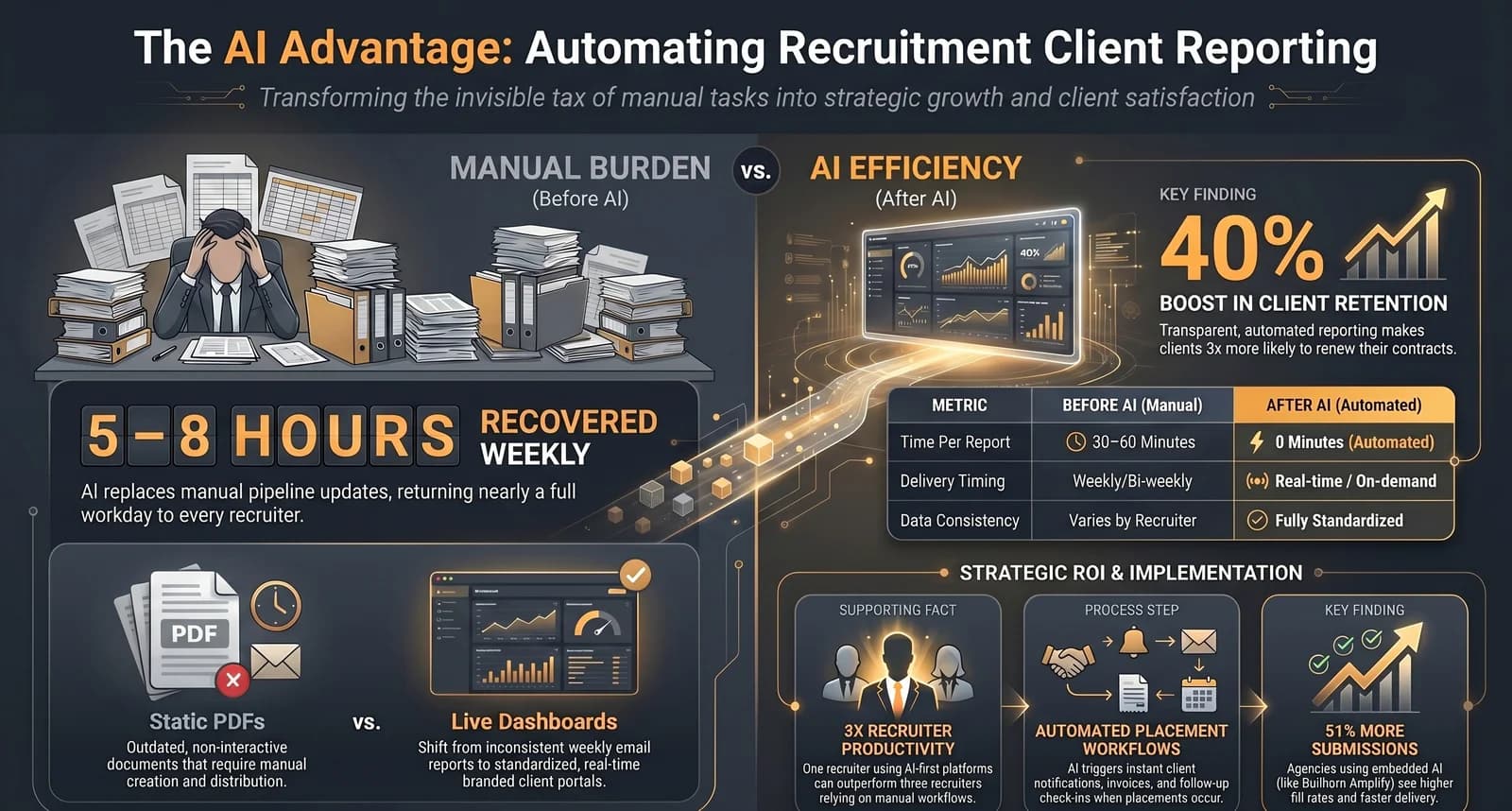
| AI reporting automation (real-time dashboards and automated weekly summaries) | Bullhorn, Vincere, JobAdder | Returns 5-8 hours per week per recruiter; 40% improvement in client retention | Enterprise |
| AI-powered productivity intelligence tracking | Prodoscore | Average productivity increase of 20% within four months | Mid-size and enterprise |
| Document automation (contracts/NDAs) and database deduplication | Kyloe (for Bullhorn) | Reduced contractor setup time from 30 minutes to 2 minutes | Small, mid-size, and enterprise |
| AI-first workflows with automated interview notes, competency scoring, and outreach | Atlas | Minimizes admin for focus on relationships; high precision shortlisting | Solo and small agencies |
| AI-powered CV formatting and branding | AssistCV by Odro | Saves 15 minutes per resume | Mid-size |
| AI-powered candidate matching and resume parsing | Mercury | Real-time visibility and data-driven decision making | Mid-size and enterprise |
| Proactive sourcing intelligence and automated multi-channel outreach | hireEZ | Faster, higher-quality placements for niche roles | Small and mid-size agencies |
| AI recommendation engine and social media data enrichment | Manatal | Build stronger shortlists faster; monitors performance via analytics | Small and mid-size agencies |
| AI candidate matching and Chrome sourcing extension | RecruitCRM | Faster shortlisting and personalized outreach at scale | Small and mid-size agencies |
| Structured hiring with AI resume screening and interview question generation | Greenhouse | Ensures fair evaluations and identifies pipeline bottlenecks | Mid-size and enterprise |
| AI-powered candidate matching and predictive search | JobAdder | Saves time on manual shortlisting of qualified candidates | Small and mid-size agencies |
Original research by ManaTech
Frequently Asked Questions
How does AI candidate-matching actually work?
A consultant pastes a new role spec into the system. AI reads the spec, identifies must-have skills, nice-to-haves, and cultural signals, then scans every candidate in the ATS using semantic matching (not just keyword search). It returns the top 5-10 candidates ranked by fit, with a written reason for each ("Strong match — 8 years senior dev experience, recently active, local to Auckland, has worked at two of your existing clients"). The consultant reviews the top of the list rather than scrolling through 500 candidates.
Can AI transcribe and score candidate intake interviews?
Yes. AI transcribes the call (audio quality is now reliable in 2026), extracts the candidate's skills, experience, salary expectation, and motivations into structured fields in the ATS, generates an intake summary in your standard template, and flags red flags or strong-match indicators. Saves 30-60 minutes of post-call admin per intake. Most NZ agencies running this report consultants doing 30-50% more intake calls per week because the post-call cost is lower.
What about candidate-ready summaries for clients?
When a candidate is ready to shortlist to a client, AI assembles the candidate-ready package — CV in your branded format, written summary aligned to the specific role, key questions for the client to ask, and any flags worth knowing. The consultant reviews and personalises rather than generating from scratch. Cuts the time from "let me put a candidate in front of you" to "here is the candidate" from hours to minutes.
How does AI handle onboarding paperwork in NZ?
Once a placement is confirmed, AI generates the employment agreement, IRD forms (KiwiSaver opt-in, IR330), induction pack, and reference letters from the placement record. The candidate receives a single onboarding link with all paperwork pre-filled. The consultant signs off; the candidate signs once. Cuts placement admin from 2-3 hours to 30 minutes per placement.
Does AI compromise the relationship side of recruitment?
Only if it is used badly. AI used to replace consultant judgement compromises the relationship; AI used to remove admin friction strengthens it because consultants have more time for client meetings, candidate care, and complex problem-solving. The NZ recruitment agencies that win with AI use it as a force multiplier on consultant time, not a substitute for consultant work.
How long does it take to deploy AI in a recruitment agency?
For a single-workflow build (e.g. candidate-job matching), 4-8 weeks from kickoff to consultants using it daily. For a practice-wide setup covering 4-5 workflows, 3-6 months with phased rollout. Most NZ agencies start with candidate matching, prove the placement-rate uplift over 90 days, then expand.
Think You've Got It?
10 questions to test your understanding — instant feedback on every answer
Question 1 of 10
According to the AdAI Research Team, how many hours per week does a recruiter typically reclaim by automating client reporting?
Question 2 of 10
What is identified as an essential first step in the implementation guide for automating client reporting?
Question 3 of 10
In Bullhorn's 'S.E.A.' framework for AI datasets, what does the 'E' stand for?
Question 4 of 10
Which tool is specifically recommended for maintaining data integrity by parsing and structuring resume data as it enters the system?
Question 5 of 10
According to the GRID 2026 report, how much more likely are top-performing staffing firms to be using AI compared to their peers?
Question 6 of 10
How does Prodoscore generate a productivity score for recruiters without tracking hours worked?
Question 7 of 10
Which platform offers 'Magic Columns' for competency scoring to help recruiters shortlist talent based on objective data?
Question 8 of 10
Referoo includes a feature that helps identify new business opportunities during the compliance phase. How is this achieved?
Question 9 of 10
What primary problem does CandidateIQ by Vettd address within a recruitment agency's ATS?
Question 10 of 10
According to the GRID 2025 Talent Trends Report, what percentage of candidates abandoned a recruiter due to slow processes or lack of communication?
Related Content
Building an AI Employee: Custom Applications That Replace Repetitive Tasks
How custom-built AI systems act as digital employees, handling meeting notes, inbox management, analytics, and onboarding so your team can focus on growth.
Read more →blogWhen Should You Outgrow Zapier and Build a Custom Automation System?
Zapier is the right tool until it is not. When your automation bill exceeds $500-1,000 per month, workflows break at critical moments, or you need logic that a visual builder cannot express, it is time to consider a custom automation system. One company went from $600 per month on Zapier to $75 per month with a custom build.
Read more →blogHow to Build AI Agents for Your Business Without Writing Code
AI agents go beyond chatbots — they take actions, make decisions, and complete multi-step workflows autonomously. IDC expects AI copilots embedded in 80% of enterprise apps by 2026. Here is how to build your first AI agent without code.
Read more →blogAI Voice Agents for Business: The Complete 2026 Guide
AI voice agents handle inbound calls, qualify leads, and book appointments 24/7 — without hiring staff. This guide covers what they are, what they cost, and how to deploy one for your business.
Read more →blogHow to Measure the ROI of AI Automation in Your Business
AI automation delivers measurable returns in 90-180 days when scoped correctly — but 95% of AI projects fail because businesses skip baseline measurement. Here is a practical framework for measuring AI ROI across efficiency, revenue, and cost reduction.
Read more →Want to explore this topic further?
Book a free discovery call to discuss how ManaTech can help your business implement these ideas.
Book a Discovery Call