
AI for NZ Legal Practices: A Practical Guide for Lawyers in 2026
Quick Answer
NZ lawyers in 2026 should automate four things first: client intake and conflict checking, document drafting from precedent, billing and timekeeping, and AML/CFT compliance documentation. Most NZ practices already use LEAP or Actionstep — AI sits on top via API, not as a replacement. Typical NZ legal practices (3-25 lawyers) recover 8-12 hours per lawyer per week and pay back custom AI builds inside 4-6 months without compromising NZLS compliance.
Key Answers
- What is the highest-ROI AI workflow for an NZ law firm?
- Document drafting from precedent. AI reads the matter type, client details, and precedent library, generates a first-draft document in your firm's style, and presents it for the lawyer to review and personalise. Saves 60-90 minutes per document on routine matters (leases, simple wills, employment agreements, NDAs).
- Does AI work with LEAP, Actionstep, or MyCase?
- Yes — LEAP and Actionstep are the dominant NZ legal practice management systems, both have APIs that custom AI agents can read and write to. AI typically reads matter, client, and document data and writes back drafts, time entries, and conflict reports.
- Will AI replace NZ lawyers?
- No. Legal advice in NZ is regulated by the NZLS — only an admitted lawyer can give legal advice. AI removes the work that does not require legal judgement (data entry, drafting from templates, research summarisation, time recording) and frees lawyers to do the work that does — advice, negotiation, court appearances, complex matter management.
- How much does an AI build cost for an NZ legal practice?
- A focused custom build (one workflow — e.g. document drafting) runs $10,000-$20,000 NZD plus $800-$1,500/month. A practice-wide AI Operating System covering 4-5 workflows runs $30,000-$70,000 NZD plus $2,000-$4,000/month. Most NZ legal practices see payback inside 4-6 months from billable-hour recovery alone.
- Is client data safe and NZLS-compliant when using AI?
- Yes, when built correctly. AI runs inside the firm's own Microsoft 365 or Google Workspace tenant with NZ data-residency commitments. Generic US-based AI tools that pipe client matter data without residency guarantees should never touch privileged client data — this is both an NZLS conduct issue and a Privacy Act 2020 issue.
Key Takeaways
- Document drafting from precedent is the highest-leverage AI workflow for NZ legal practices — 60-90 minutes saved per routine document, with the lawyer reviewing rather than drafting.
- AI never gives legal advice — that requires NZLS admission. AI does the prep, research, and admin; lawyers do the advice, negotiation, and judgement work.
- LEAP and Actionstep dominate the NZ legal practice management market and have mature APIs for the four highest-ROI AI workflows. Both integrate with Xero for trust accounting.
- AML/CFT compliance prep is one of the strongest AI use cases — AI assembles the customer due diligence file, flags risk factors, and presents a compliance officer with a sign-off-ready package, but does not make the compliance decision.
- Custom AI builds for NZ legal practices typically pay back in 4-6 months from billable-hour recovery alone, often substantially faster when factoring in capacity to take on more matters per lawyer.
Why NZ Legal Practices Need AI Now (and Why It Is Not Optional)
NZ legal practice in 2026 faces a structural margin squeeze. Hourly fees are under pressure, clients expect faster turnaround on routine matters, and the compliance overhead (NZLS conduct rules, AML/CFT, trust accounting requirements, Privacy Act 2020 obligations) keeps growing. The traditional response — work longer hours or hire more juniors — has hit its ceiling. The 2025 NZLS practising certificate data shows partner-level lawyers in mid-size firms billing fewer hours than five years ago and feeling more burnt out, while client expectations on speed continue to rise. Something has to give.
AI is the lever that gives without forcing the firm to grow headcount or sacrifice quality. The 2026 generation of legal AI tools is materially better than the 2024 versions — they understand NZ legislation, draft in NZ legal English, integrate with LEAP and Actionstep, and respect the NZLS conduct rules around confidentiality and unauthorised practice. The firms deploying AI well are billing the same rates with 20-30% more capacity per lawyer. The firms that wait another 12 months will find themselves competing against firms quoting same-day on routine matters that took them three days a year ago.
The 5 Highest-ROI AI Automations for an NZ Legal Practice
Most NZ law firms have a precedent library that consumes more time to maintain than to use. AI changes that economics. AI reads the matter type, captures the client and counterparty details, picks the right precedent from the firm's library, applies the matter-specific facts, and produces a first-draft document in the firm's house style. The lawyer reviews and personalises. For routine documents (leases, simple wills, employment agreements, NDAs, trust deeds in standard form, debt recovery applications) the saving is consistent: 60-90 minutes per document on what used to be a 90-120 minute drafting task. Across a firm doing 20-50 routine documents a week, the recovered time is substantial.
Client intake in an NZ law firm is mechanical: take the client details, run the conflict check against historical matters, draft the engagement letter, set up the matter in LEAP or Actionstep, request the AML/CFT documents. AI runs the entire pipeline: intake form is filled out by the client (or by the lawyer in the client's presence), AI runs the conflict check semantically across the matter database (looking for direct conflicts and material adverse interest patterns), drafts the engagement letter from the firm's template, sets up the matter, and queues the package for the supervising lawyer. Intake-to-engagement time drops from days to hours.
AML/CFT compliance is the textbook AI use case in legal practice — high-volume, document-heavy, rule-based, and exactly the kind of work that drains junior lawyer time. AI assembles the customer due diligence file from intake, runs the standard sanctions and politically-exposed-person checks against the global lists, generates the source-of-funds summary from supporting documents, and presents a compliance officer or supervising lawyer with a sign-off-ready package. The compliance officer reviews and signs; AI does the assembly. 2-4 hours of AML/CFT prep compresses to 20-30 minutes of review per matter. Across a busy property or commercial law firm, the recovered time is meaningful.
Self-reported time tracking under-captures billable hours by 10-20% in almost every law firm. Lawyers move between matters too fast to record everything in real time. AI tracks time passively from calendar events, email metadata (not content), document edits in LEAP or Actionstep, and matter-related activity, then presents the lawyer with a daily review screen of pre-classified time entries to approve or correct. The lawyer reviews and approves rather than recreating from memory. Capture rate typically improves 10-20% in the first month; that revenue improvement alone often covers the AI build cost in the first year.
NZ legal research is asymmetric work — the partner asks a question, the junior spends 2-3 hours reading judgments and writing a memo. AI compresses the read-and-summarise stage. The lawyer asks the question, AI surfaces the relevant authorities (with proper citations to NZLII or LexisNexis), summarises the key holdings, and writes a draft memo. The lawyer reads the actual cases for anything load-bearing — AI is the research assistant, not the legal opinion. Junior lawyer research time drops by 50-70% per matter, and partner review time stays the same because the lawyer still reads the cases. Net effect: more matters move forward per week with the same lawyer team.
NZ-Specific Tools and Integrations
LEAP is the dominant practice management system in the NZ legal market and the most common starting point for AI integration. Actionstep is the second-most-common, particularly with commercial and mid-size firms. MyCase appears occasionally. All three have APIs that AI agents can read and write to. Underneath the practice management layer, Xero handles trust and general accounting, with explicit Trust Account Practice Rules that AI workflows must respect. The data ecosystem is mature enough in 2026 that an AI build can integrate with LEAP or Actionstep, Xero, the firm's document management system, and the firm's email and calendar in a single coherent build.
NZLS conduct rules and Privacy Act 2020 obligations make data residency the most important architectural decision in any legal AI build. Privileged client communications and matter files cannot flow through generic US-based AI SaaS without explicit residency commitments — this is both an NZLS conduct issue (client confidentiality) and a Privacy Act issue. The right pattern in 2026 is to run the AI inside the firm's own Microsoft 365 or Google Workspace tenant, both of which provide AI offerings (Copilot and Gemini) with data-handling commitments suitable for legal practice.
Cost vs ROI for an NZ Legal Practice
A focused custom AI build for one workflow (e.g. document drafting) runs $10,000-$20,000 NZD plus $800-$1,500 monthly support. A practice-wide AI Operating System covering 4-5 workflows runs $30,000-$70,000 NZD plus $2,000-$4,000/month. LEAP has built-in AI features in 2026 worth using as a starting point — but they are generic across all firms and rarely fit the firm's house style, the firm's precedent library, or the firm's specific compliance approach. Most growing NZ legal practices outgrow the SaaS AI tier within 12-18 months.
The maths on payback is sharp because legal billing is hourly. A 10-lawyer NZ practice billing $400-$600 per hour with current capture of 1,400-1,500 chargeable hours per lawyer per year carries a $5.6M-$9.0M billing base. An AI build that recovers 8-12 hours per lawyer per week and lifts time-capture by 10-15% adds $500,000-$1,000,000 of recoverable annual revenue. A $50,000 build pays back in the first month of recovered billing. The NZ legal practices that have already deployed AI report consistent payback inside 4-6 months from billable hour recovery alone, before any quality or capacity uplift.
How to Get Started Without Compromising NZLS Compliance
Three principles for any NZ legal practice deploying AI in 2026. First, the lawyer is always the principal. Every AI output gets reviewed by an admitted lawyer before it leaves the firm. AI is the prep layer, never the advice layer. Second, data residency and confidentiality are non-negotiable. Build inside Microsoft 365 or Google Workspace tenants with explicit AI data commitments; do not pipe matter data to generic US AI SaaS. Third, document the AI use in your firm's practice management policies. The NZLS expects lawyers to know how their work is produced; an internal AI policy that defines what AI does and does not do, and how lawyers verify outputs, is the appropriate response.
Beyond the principles, the deployment sequence matters. Pick the workflow with the highest hourly bleed (usually document drafting or AML/CFT) and build it first. Get it in the lawyers' hands inside 8 weeks. Measure the time recovered and the quality of the output. Once it is trusted, expand to the next workflow. Most NZ practices that succeed with AI followed this exact sequence; most that stalled tried to deploy across the practice in one go and lost momentum on change management.
If you are running an NZ legal practice and want to map the right AI workflow for your firm size, practice areas, and current LEAP or Actionstep setup, book a 30-minute discovery call. We will look at your current practice management system, identify the workflow with the highest billable-hour leverage, walk through the NZLS compliance considerations, and tell you what a 90-day pilot looks like — or recommend a SaaS AI tier instead if that is the right call for your size.
Research Data
Key strategies and factors based on original research
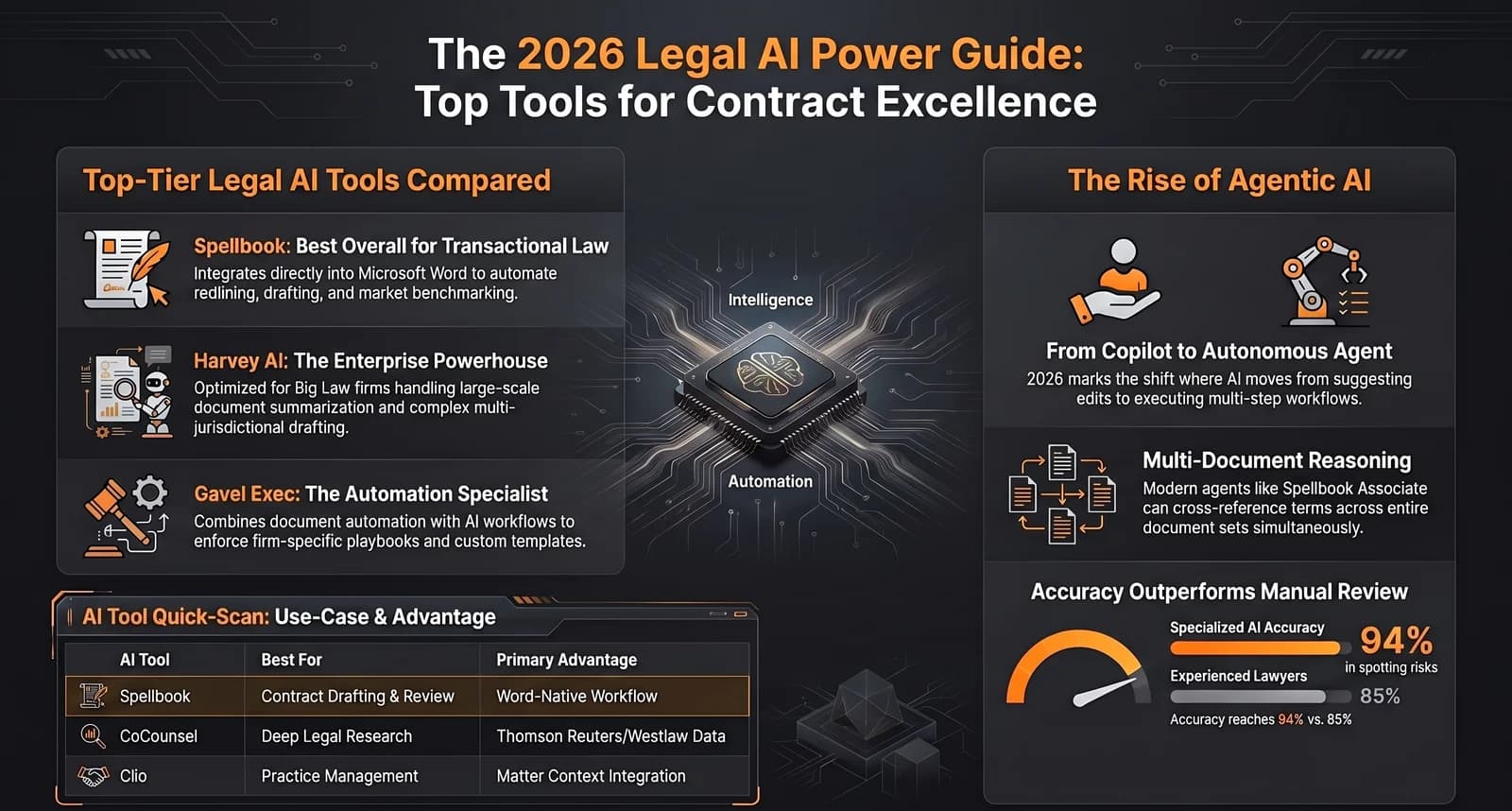
| tool name | specialty | integration | best for firm size | Key Features | Pricing Model | Primary Strength |
|---|---|---|---|---|---|---|
| Spellbook | Contract review, drafting, and analysis | Microsoft Word (Native), iManage | Solo, small, and mid-sized firms | AI-powered redlining, clause-level explanations, industry benchmarking, and Spellbook Associate for multi-document workflows. | Mid-tier | Native Microsoft Word integration providing an intuitive, all-in-one suite for commercial legal work. |
| CoCounsel (Thomson Reuters) | Legal research and contract analysis | Westlaw, Microsoft Word | Large firms and busy legal departments | Inline citations, side-by-side document comparison, automatic timeline creation, and deposition prep assistance. | Tiered Subscription (Enterprise-level) | Deep legal research capabilities backed by extensive Thomson Reuters and Westlaw databases. |
| BoostDraft + Actionstep | Contract drafting and practice management | Microsoft Word, Actionstep | Mid-sized firms | Automated formatting, identification of definition mismatches, cross-reference error checking, and integrated matter management. | Subscription-based (Mid-tier) | Eliminates drafting bottlenecks by aligning contract data with practice management processes. |
| Harvey AI | Large-scale drafting, research, and bulk review | iManage, SharePoint, Microsoft Word | Large firms (Am Law 100) and enterprise teams | Automated summarization of large document sets, multi-jurisdictional drafting, and custom tax AI assistant. | Custom Enterprise | High processing power for massive M&A due diligence and complex multi-step legal drafting. |
| Clio | Practice management and matter summaries | All-in-one ecosystem (Manage, Grow, vLex) | Solo, small, and mid-sized firms | Billing, deadline extraction, matter summaries, and automated client communications. | Tiered Subscription | Centralizes firm operations into a single command center with integrated AI insights. |
| Gavel Exec | Contract drafting and redlining | Microsoft Word, Clio, Docusign, Zapier | Solo, small, and mid-sized firms | Precedent-based drafting, market-based clause comparison, and Projects feature for firm-specific training. | Subscription-based | Functions as a senior associate inside Word with strong zero data retention (ZDR) privacy standards. |
| Luminance | High-volume analysis and due diligence | Enterprise platform | Global 2000 and Large firms | Institutional memory architecture, visual heatmaps for risk flagging, and unsupervised learning for review scaling. | Custom Enterprise | Analyzes 10,000+ documents rapidly while maintaining negotiation consistency across global jurisdictions. |
| LegalFly | Contract review and regulatory monitoring | Microsoft Word, Microsoft Teams | Mid-sized to large corporate legal teams | Anonymization of PII for GDPR compliance, Agent studio for custom workflows, and modular design. | Enterprise-oriented | Privacy-first architecture that scrubs sensitive data before it reaches AI models. |
| Ivo | Playbook-based redlining and analytics | Microsoft Word | Enterprise in-house legal teams | Rule-based clause library, relationship mapping, and benchmarking against internal precedents. | Custom Enterprise | High accuracy (97%) on the Atticus Dataset for enforcing strict corporate legal standards. |
| goHeather | Affordable contract review | Microsoft Word, PDF | Solo practitioners and SMBs | Side-aware analysis (Buyer vs. Seller), plain English explanations, and jurisdiction-specific flagging. | Mid-tier | Provides an accessible second set of eyes for legal review without enterprise complexity. |
Original research by ManaTech
Frequently Asked Questions
How does AI handle client intake and conflict checking in an NZ law firm?
AI runs the intake form, captures client and matter details, runs the conflict check against the firm's historical matter database (looking for direct conflicts and material adverse interests), prepares the engagement letter from the firm's template, and queues the package for the supervising lawyer to review and authorise. Cuts the intake-to-engagement time from days to hours, with the lawyer making every conflict and engagement decision.
Can AI draft contracts and pleadings reliably?
For routine, high-volume documents — yes. Leases, simple wills, employment agreements, NDAs, trust deeds in standard form, debt recovery applications, simple court documents. AI drafts from the firm's precedent library, applies the matter-specific facts, and produces a first draft that is 80-90% complete. The lawyer reviews and personalises. For complex or bespoke drafting (high-stakes commercial contracts, novel court submissions), AI is a research and structuring assistant rather than a drafter — it surfaces relevant precedents and clause patterns but the lawyer drafts.
What about legal research and case law summarisation?
AI summarises NZ case law, reads through long judgments, and surfaces the relevant authorities for a specific question. It cites everything and shows the lawyer the source paragraphs. The lawyer reads the actual cases for anything load-bearing — AI is not the source of legal opinion, it is the research assistant. Saves 1-3 hours per matter on initial research.
How does AI help with AML/CFT compliance?
AML/CFT compliance is high-volume, document-heavy, and rule-based — exactly what AI is good at. AI assembles the customer due diligence file from the client intake data, runs the standard sanctions and PEP checks, generates the source-of-funds summary from the documents the client provides, and presents the compliance officer with a sign-off-ready package. The compliance officer signs off; AI handles the assembly. Cuts AML/CFT prep from 2-4 hours per matter to 20-30 minutes of review.
Will AI track time and bill more accurately than I do?
Yes. AI tracks time passively from calendar events, document edits, email activity, and matter activity in LEAP or Actionstep. At the end of each day, the lawyer reviews and approves time entries that have been pre-classified to the right matter. Lawyers using AI time tracking typically capture 10-20% more billable time than self-reported, simply because nothing falls through the cracks. The accuracy improvement alone often pays for the AI build.
Is AI use compatible with NZLS rules of conduct?
Yes, with care. The NZLS expects lawyers to maintain client confidentiality, provide competent advice, and not delegate legal advice to non-lawyers. AI used for admin and drafting (with lawyer review) is fully compatible. AI giving advice directly to clients without lawyer review is not. Most NZ firms running AI in 2026 have an internal policy: AI is the assistant, the lawyer is the principal, every output gets reviewed by a lawyer before it leaves the firm.
Think You've Got It?
10 questions to test your understanding — instant feedback on every answer
Question 1 of 10
According to the 2026 data, what is the reported accuracy rate for AI-powered contract tools in identifying risks within Non-Disclosure Agreements (NDAs), compared to experienced lawyers?
Question 2 of 10
Which specific category of AI software is described as being able to take a single prompt, execute tasks across multiple documents, and check its own work, such as 'Spellbook Associate'?
Question 3 of 10
In the context of implementing AI contract management, what is the primary focus of 'Phase 1: Pilot Program'?
Question 4 of 10
Which legal AI tool is specifically ranked as the 'Best for Litigation Analytics', providing insights into judge behavior and case outcomes?
Question 5 of 10
A lawyer wants to use AI to find specific risks in a SaaS contract regarding data privacy. According to the source material, which prompt would be considered 'precise' for an effective result?
Question 6 of 10
What distinguishes the strategic partnership between BoostDraft and Actionstep announced in early 2026?
Question 7 of 10
According to the Gavel guide, why is 'Zero Data Retention' (ZDR) considered a critical standard for lawyers using AI assistants?
Question 8 of 10
How does 'AI Contract Management' differ from 'Traditional CLM Software' as defined in the source material?
Question 9 of 10
Which of the following is identified as a potential limitation or 'pitfall' of using general-purpose AI like ChatGPT for legal work?
Question 10 of 10
Which tool is recommended specifically as a 'privacy-first' option for regulated industries like banking, due to its ability to automatically anonymise PII?
Related Content
Building an AI Employee: Custom Applications That Replace Repetitive Tasks
How custom-built AI systems act as digital employees, handling meeting notes, inbox management, analytics, and onboarding so your team can focus on growth.
Read more →blogWhen Should You Outgrow Zapier and Build a Custom Automation System?
Zapier is the right tool until it is not. When your automation bill exceeds $500-1,000 per month, workflows break at critical moments, or you need logic that a visual builder cannot express, it is time to consider a custom automation system. One company went from $600 per month on Zapier to $75 per month with a custom build.
Read more →blogHow to Build AI Agents for Your Business Without Writing Code
AI agents go beyond chatbots — they take actions, make decisions, and complete multi-step workflows autonomously. IDC expects AI copilots embedded in 80% of enterprise apps by 2026. Here is how to build your first AI agent without code.
Read more →blogAI Voice Agents for Business: The Complete 2026 Guide
AI voice agents handle inbound calls, qualify leads, and book appointments 24/7 — without hiring staff. This guide covers what they are, what they cost, and how to deploy one for your business.
Read more →blogHow to Measure the ROI of AI Automation in Your Business
AI automation delivers measurable returns in 90-180 days when scoped correctly — but 95% of AI projects fail because businesses skip baseline measurement. Here is a practical framework for measuring AI ROI across efficiency, revenue, and cost reduction.
Read more →Want to explore this topic further?
Book a free discovery call to discuss how ManaTech can help your business implement these ideas.
Book a Discovery Call